

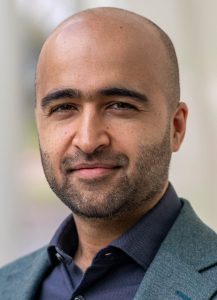
 Shahid Merali and Safiya Virji are NHS GPs and Associate Professors involved in undergraduate and postgraduate medical education. They write together here, reflecting on Merali’s experience in practice and education.
General practice is, at its core, an ethical discipline – built on commitments to equity, social justice, and responding to the effects of structural disadvantage. Much of our work involves noticing how circumstances beyond a person’s control shape their opportunities and acting in ways that uphold dignity and fairness.1
As GPs, we often meet people at points of disruption – when plans collapse and the future suddenly feels unclear.
It is within this ethical foundation that I first met Shahd Alhajjar, a medical student from Gaza whose education had been abruptly interrupted by conflict. What followed came from the same instincts that guide my work as a GP – being fully present to someone’s story, understanding the pressures and inequalities shaping their path, and responding in ways that keep their future in medicine within reach.
A conversation that became a turning point
Shahd was studying at medical school when the conflict escalated in 2023. Her university was bombed. Clinical placements disappeared. Her family fled to Russia.*
Despite everything, she entered a surgical skills competition at the University of Oxford and placed in the top seven out of more than 700 entrants.2 Following this, a chain of mutual contacts led her to my office in Birmingham, UK.
As GPs, we often meet people at points of disruption – when plans collapse and the future suddenly feels unclear. We sit with that complexity daily: listening, thinking through constraints, and identifying what next steps might be possible.
A series of small, natural steps
From the outside, this sequence might appear complex. From within, each step emerged naturally through conversations and connections. Each action was familiar in itself, but together they formed something genuinely significant.
- She was identified as an excellent fit for a donor-funded pilot programme for international students whose medical education had been interrupted by conflict or natural disaster.3
- I introduced her to colleagues at Aston Medical School.
- I offered her a clinical placement at my surgery.
- Institute colleagues developed the academic and pastoral structure around her.
- Local placement providers agreed to host more visiting students.
Supporting someone to reclaim their place in medicine is not an add-on to general practice – it aligns with its core.
Why this matters
Medical education is a vital part of global health. When training is interrupted by conflict or disaster, the consequences ripple for years: fewer clinicians, weaker health systems, and communities deprived of care.
Supporting students like Shahd is a recognition that the future healthcare workforce depends on keeping learners connected to their training.
Shahd hopes to become a GP, and her experiences have shaped that aspiration. She often reflects on the clinicians she encountered along her journey – people who continued to care for patients and support learners even in high-demand or resource-limited settings. Their steadiness left a strong impression on her. For her, continuing her education allows her to hold onto that sense of purpose, even as she navigates the disruptions she has faced.
The quiet influence of general practice
When training is interrupted by conflict or disaster, the consequences ripple for years: fewer clinicians, weaker health systems, and communities deprived of care.
What unfolded here reflects something deeper than helping one student in challenging circumstances. It illustrates the steady, relational qualities at the heart of general practice: taking time to understand someone’s story, recognising what they are trying to hold on to, and offering support that aligns with their needs and aspirations.
A single conversation became a connection; that connection became an opening; and that opening enabled a medical student to reconnect with the learning environment that sustains her.
This is the quiet influence of being a GP – not just clinically, but humanly. It is the mindset of looking beyond the immediate problem, of holding a person’s present alongside their future, and taking the steps we can to support that future.
What happened for Shahd is one example of what can emerge when these values are practised with consistency and openness – and how, in small relational moments, the true influence of general practice quietly reveals itself.
References
- Papanikitas A, Moerenhout T, Upshur R. Global primary care as an incubator for good ethical practice. Br J Gen Pract. 2022 Jun 30;72(720):310-311. doi: 10.3399/bjgp22X719813. PMID: 35773006; PMCID: PMC9256044. DOI: https://doi.org/10.3399/bjgp22X719813
- BBC News. Gazan medical student’s UK studies ‘life-changing’. Nov 2025. Available from: https://www.bbc.co.uk/news/articles/cx278z88dkdo
- Aston University. Aston Medical School welcomes first medical student from Gaza to support her interrupted learning. Oct 2025. Available from: https://www.aston.ac.uk/latest-news/aston-medical-school-welcomes-first-medical-student-gaza-support-her-interrupted
Featured Photo by Caleb Stokes on Unsplash