
 Paul Main is a Retired GP, Honorary Senior Clinical Lecturer, School of Social and Community Medicine, University of Bristol, Emeritus Deputy Director & Associate Postgraduate Dean, Severn School of Primary Care, Health Education South West.
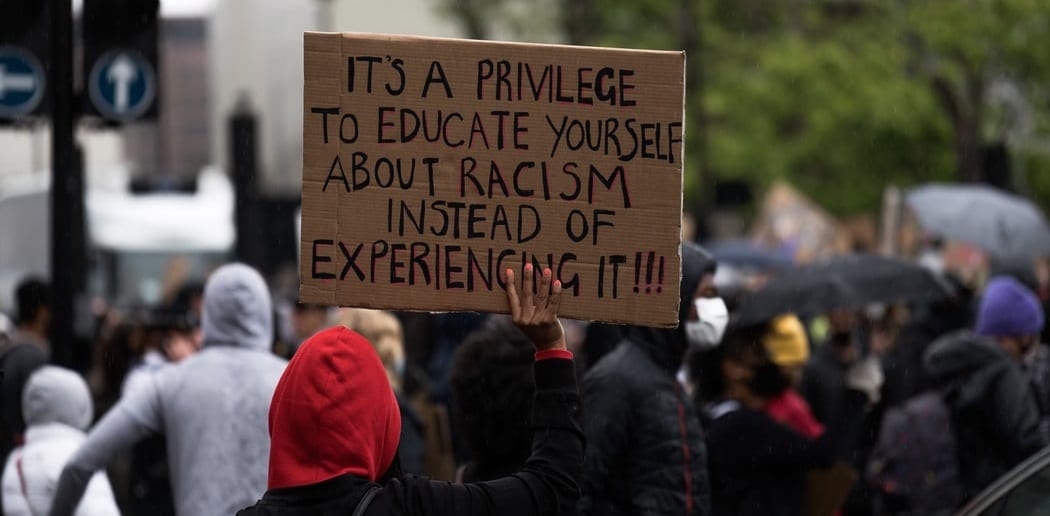
O n Sunday 7th June 2020 the eyes of the world were on Bristol when the statue of Edward Colston was toppled and pushed into the harbour during protests in support of Black Lives Matter. Although he was a philanthropist, Colston was involved in the Atlantic slave trade. Bristol has a dark history of involvement in the slave trade which has been an issue for this historic maritime city for many years.
The Bristol Bus Boycott of 1963 arose from the refusal of the Bristol Omnibus Company to employ black or Asian bus crews in the city. At the time, there was widespread racial discrimination in housing and employment against so-called “coloureds”. A boycott of the company’s buses by Bristolians lasted for four months until the company backed down and overturned their discriminative colour bar policy.
This boycott is considered to have been influential in the passing of the Race Relations Act 1965 which made “racial discrimination unlawful in public places” and the Race Relations Act 1968, which extended the provisions to employment and housing. It has been likened to a UK civil rights moment.
In the inner city St Paul’s district of Bristol, the riots of 1980 arose as a consequence of racial tensions between black members of the community and the police, including concerns over “sus laws”1, poor housing and alienation of black youth.
With encouragement and advice from my adult children I have recently read two books which have helped to inform and educate my understanding and attitudes.
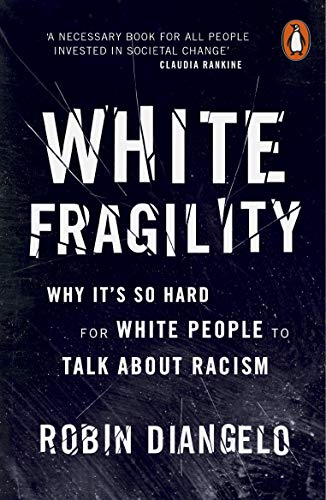 Robin Diangelo is a white American academic sociologist who has worked as a diversity trainer across the US. She describes white fragility as not just defensiveness and whining, but the inability of white people to tolerate racial stress. This, she says, leads to white people being indignant and defensive when confronted with racial inequality and injustice. It is the outcome of white people’s socialisation into white supremacy and a means to protect, maintain and reproduce white supremacy. She helps the reader to understand that this way of seeing the world isn’t restricted to ‘bad people’. Her book is full of illuminating stories from her diversity workshops which illustrate the phenomenon. She unravels white claims like; ‘I marched in the sixties’, ‘I know people of colour’, ‘you’re being racist against me’, etc. Although this book is written by an American for white people, its message is useful for British citizens of all diversities.
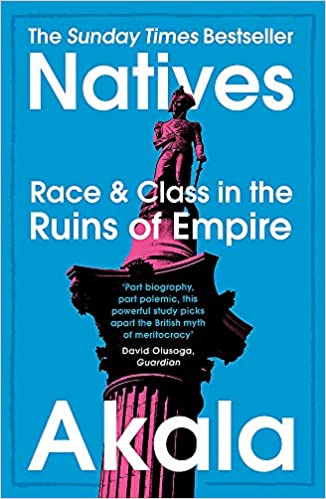 The second book by Akala is an engaging mixture of autobiography and political history of Empire. He is a famous rapper and poet, the child of a British Jamaican father and a Scottish mother, who despite no education after his GCSEs, has lectured at many universities, spoken at the Oxford Union and given TED talks. This book yet again demonstrates the power of stories principally from his mixed race working class background. His narrative is wide ranging from empire and slavery to Mandela, Castro and the Ku Klux Klan. He talks about the decline of whiteness, which appears to be causing real fear in Trump’s heartlands in the USA. This is a thoughtful, but challenging book which should to be read by white communities. There is an extensive bibliography and each chapter is referenced in detail.
I now understand that people of colour have to think about racism every day of their lives whereas I rarely have to. I am also struck by how such an obvious and important fact of the world had been invisible to me.
I live in Bristol and am a retired GP having served a largely white population on a large council housing estate; one of the many forgotten areas of deprivation. These books have helped me understand more clearly the structural and institutional aspects of racism that help to maintain white privilege and superiority. I now understand that people of colour have to think about racism every day of their lives whereas I rarely have to. I am also struck by how such an obvious and important fact of the world had been invisible to me. Bernardine Evaristo, the recent Booker prize winner, recently stated that white people need to be a party to the discussion about race and not just consider it to be a BAME issue. Here in Bristol the mixed race elected Mayor has, since the Colston event, set up Bristol History Commission, so that Bristolians can discover the diverse and problematic background that has shaped this historic city. This has never been done before and hopefully it will help to foster understanding and heal wounds.
Books:
White Fragility: why it’s so hard for white people to talk about racism. Robin Diangelo. Penguin Books, 2018, PB, 168pp, £9.99, 978-0-141-99056-9
Natives: Race and class in the ruins of Empire. Akala. Two Roads, 2019, PB, 343pp, £8.99, 978-1-473-66123-3
Footnote
- The “sus law” (from “suspected person”) was a stop and search law that permitted a police officer to stop, search and potentially arrest people on suspicion of them being in breach of section 4 of the Vagrancy Act 1824.
Featured photo by James Eades on Unsplash