

 Becca Quinn has worked as a GP in London for 15 years. She is currently part of a wonderful GP practice in Battersea and continues to be inspired by the dedication and energy of her colleagues.
In our ‘mindful’ generation, we have seen a rise in mental health awareness and a burgeoning focus on wellbeing. Yet rates of mental illnesses are still skyrocketing. Where have we gone wrong?
In this provocative book, Consultant Child and Adolescent Psychiatrist Sami Timimi sets about deconstructing our concept of mental health. Each chapter is book-ended with patient encounters collected across his years of experience, and are scenarios that we could instantly recognise from our own practice.
“Is an all-out pursuit of wellbeing healthy? Will this aversion of suffering drive out development of resilience?”
He begins by pointing out the difficulty of objectively defining mental health and illness across different countries and cultures. Most African and Asian countries tend towards a collectivist culture, stressing the importance of unity and altruism. Western countries stress the individual, with autonomy and identity being valued more highly. In this context, he asks, what is wellbeing?
He explains, ‘personhood in the Iraqi culture of my childhood is relational. The idea of self-care, self-love is not only culturally absent, but positively strange to someone whose concept of self is defined by relationships. How can you feel better in yourself without others to feel better with?’
From this standpoint, questions abound. Is an all-out pursuit of wellbeing healthy? Will this aversion of suffering drive out development of resilience? Are negative emotions all to be suppressed, in pursuit of a permanent state of ‘wellbeing’? Is what we hold out to patients actually attainable? Are we doing them a disservice by claiming it is?
Timimi then tackles the concept of diagnoses in mental illness. He reminds us that unlike in physical disease processes, there is no objective, biological test to identify mental disorders. Diagnoses are based on a collection of symptoms and behaviours. The categories used in diagnostic manuals such as the Diagnostic and Statistical Manual of Mental Disorders (DSM) lack causal or physiological frameworks to explain them. In effect, he says ‘psychiatric diagnoses are … facts of culture rather than facts of nature.’
While making for uncomfortable reading, we acquiesce that explaining ‘my low mood is caused by depression’ is akin to saying ‘the pain in my head is caused by a headache’.
Timimi asserts that psychiatric diagnoses rest on cultural or social bases and are therefore fluid. For example, the diagnosis of ‘moral insanity’ associated with women having a child ‘out of wedlock’ is now thankfully obsolete. Homosexuality was included in the American DSM until 1973.
Timimi argues that as social constructs, psychiatric diagnoses are then amenable to commodification and brand expansion. He presents mental health as an ideology that is marketable and describes an industrialisation of mental health-related products propounded not only by the pharmaceutical industry, but also by psychological therapies.
I found this systematic deconstruction of our conventional approach to psychiatry profoundly disturbing. Managing patients with mild-to-moderate mental health concerns is part of the bread and butter of general practice, and this was not what I wanted to hear. However, while difficult to digest, there were several things that resonated.
“He presents mental health as an ideology that is marketable and describes an industrialisation of mental health-related products …”
The idea of ‘concept creep’, where diagnostic thresholds of a condition gradually expand outwards and downwards, captures what many of us are seeing in primary care. On cue come his chapters on neurodiversity, which he handles in depth. A brief look at his take on attention deficit hyperactivity disorder (ADHD) presents an unsettling state of affairs.
Timimi goes back to the idea of safe science — the null hypothesis. He proposes that the case for ADHD as a biologically based, genetically linked condition is not actually proven, and produces a comprehensive walkthrough of the evidence for his reasoning.
Timimi quotes that referrals for assessment for ADHD to the NHS-commissioned private company ‘Psychiatry UK’ quadrupled between 2020 and 2022. Correspondingly, general practice has seen a huge increase in requests for prescriptions for stimulant medication. Our unspoken unease at this will not be assuaged by Timimi, who highlights the risk of dependence-forming habits, and points out the dangers of long-term downregulation of dopamine. Timimi warns that a population-based Swedish study found that patients diagnosed with ADHD on long-term use ADHD medications showed an association with hypertension and arterial disease. Another study demonstrated an association with patients taking long-term stimulants and Parkinson’s disease.
He questions findings from the Multimodal Treatment Study of Children with ADHD (MTA) study,1 whose 14-month outcomes formed the basis of the 2008 National Institute for Health and Care Excellence guidelines that recommend stimulant medication as first line for ADHD with severe symptoms. Follow-up studies at 3 years and 8 years showed the treatment group did not perform better and had more side effects.
His examination of concept creep around autism and his investigation into the evidence behind autism as an evidence-based construct is deeply engaging and leaves us with more questions — what drives adult patients to wonder if they are autistic? Is it ‘a new catch all for young patients who do not follow the increasingly narrow boundaries of expected behaviour?’
“I am now left with the unsettling feeling that I am in the wrong lane on the motorway in the wrong gear.”
Timimi is clearly not convinced by the effectiveness of the current mental health ideology and its treatments. The rising diagnoses and attendant prescriptions and therapies are apparently not matched by improved outcomes, and he provides a challenging plethora of evidence for this.
He examines the psychotherapeutic models and wonders if they are just sanitised versions of Western common sense folk psychology. He takes us to the political drive behind the creation of the Improving Access to Psychological Therapies initiative (now the NHS Talking Therapies programme) in 2007 and its aim to get the depressed and anxious back to work.
The evidence behind antidepressant and antipsychotic medication are also hauled out and dissected. The Moncrieff systematic umbrella review published in 2022 challenges the idea of an association between serotonin levels in the brain and depression.2 Timimi points out the potential harms of believing that low mood is due to an organic brain dysfunction, encouraging creation of long-term patients.
At best, Timimi states, these drugs produce the effect of muting emotions to give temporary relief. They should not, he argues, be called ‘anti’ depressants or ‘anti’ psychotics; they do not cure, they have side effects, and they have discontinuation symptoms. I am now left with the unsettling feeling that I am in the wrong lane on the motorway in the wrong gear.
“As we have seen it, is our Western-based diagnostic framework justified in imposing itself on patients with an entirely different history and culture?”
And that is not all. Timimi then launches into the concept of colonial psychiatry. As we have seen it, is our Western-based diagnostic framework justified in imposing itself on patients with an entirely different history and culture? What is lost with a reductionist approach that loses the layers of cultural significance and contextual anchoring that is associated with a condition? Which makes me wonder about our unspoken ways of practising in primary care. Are we too ready to dismiss our African and South Asian patients with ‘all over body pain’? Are we presumptuous enough to assume that some cultures somatise because they are not able to process or understand their distress?
Having systematically demolished much of the bedrock from which we operate in primary care, we are left scrabbling for some alternative ground to stand on. What are the alternatives from here?
Timimi espouses a systemic philosophy in which the patient is the ‘nexus’ of a network of relationships and cultural and social factors that shape their mentalising of and response to circumstances. He shows the importance of helping patients to create a ‘meaning making framework’ on which they can understand their experiences. He points out that the trend to pathologise undesirable feelings has meant that the ability to process emotional reactions and move towards resilience has been stunted. He reminds us that diversity of feelings are the norm.
From his clinical perspective, formulations and interventions for patients are best done when we understand patients in the context of their networks, and when we recognise their dynamic potential for development and change. He adopts a more narrative medicine-based approach, believing that the root benefit of therapy lies in the interaction between the therapist and the patient, regardless of the mode of therapy offered.
He points towards the open dialogue mental health system in Finland,3 and the Trieste Model of mental health care in Italy,4 where such approaches have resulted in a marked reduction of inpatient numbers.
Logically, approaching patients in the context of systems forces a look at the political structures in which society functions. Tamimi writes about our current ‘compare and compete’ meritocracy in which hierarchy pervades work, social, and economic spheres. The rebound effects of increased inequality on identity and sense of wellbeing is, he argues, a root cause of much of our distress. He argues that in an individualistic society, our failures are personal. At this point, he notes, market logic leaps in to commodify this distress, promote diagnoses, and introduce patients to the ‘mental health industrial complex’.
“… I found it hard to sift out his often valid points from the more neo-Marxist refrains that permeate …”
Many of Timimi’s points ring true and should pave the way for further thought on the organisation and provision of psychiatry services. However, I found it hard to sift out his often valid points from the more neo-Marxist refrains that permeate the latter chapters of the book.
Nevertheless, for us humble beings in general practice, this book holds immense value. It gives us a context to the tide of confused patients sweeping through the doors and gives us courage to take up different tools to grasp their histories. It authenticates our sneaking feeling that indeed ‘one size does not fit all’ when it comes to treatment for mental illness and rightly challenges our attitudes to patients who are labelled ‘treatment resistant’ or ‘chronic’.
It validates an approach of expectation setting with patients, of naming resilience, and looking at some emotions as being part of the diverse ocean that takes us on life’s journey rather than being diseases to be expunged. We are reminded of the value of community engagement and heave a sigh of gratitude towards our social prescribers and health coach colleagues.
We are reminded of the need for more humility towards our patients from other cultures. We are given permission to take time to elicit ‘the scaffolding onto which they are staking their experiences’, and establish a treatment strategy that is relevant.
We might, in short, take a different approach to defining ‘normal’ and help our patients towards an understanding of distress that is not shoe-horned into pre-packaged diagnoses that lead into the twin approaches of talking therapy and medication.
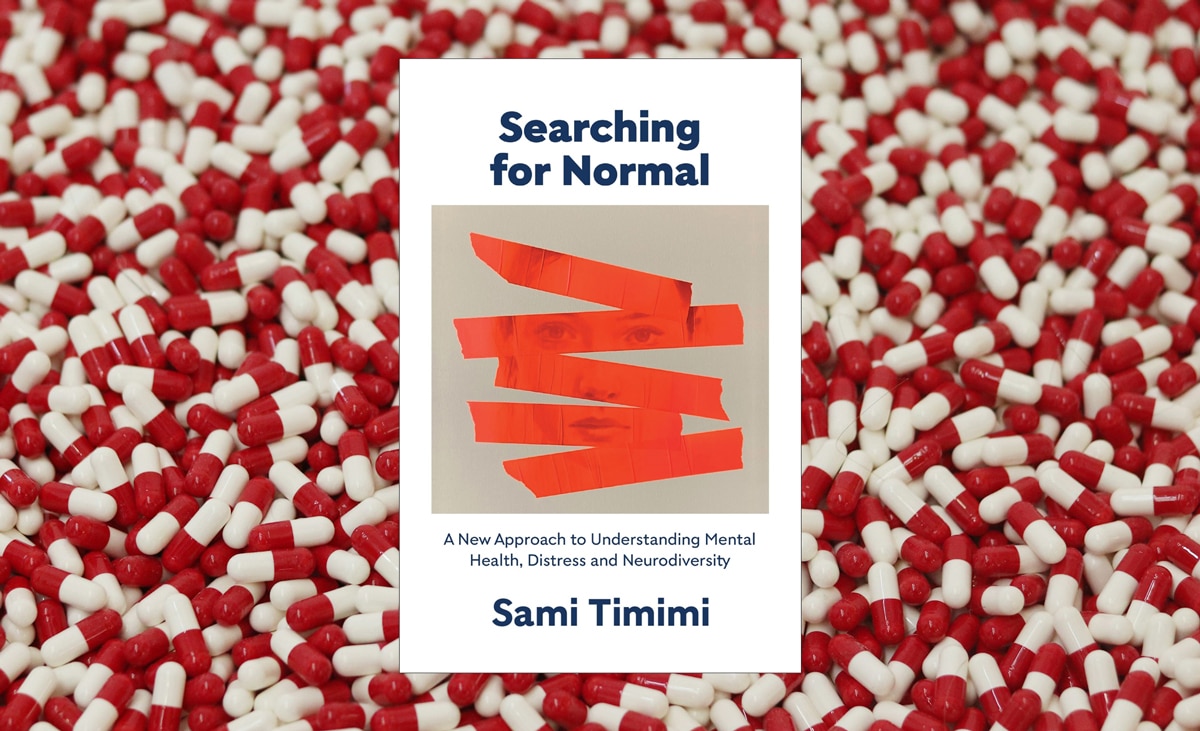
Featured book: Sami Tamimi, Searching for Normal: A New Approach to Understanding Mental Health, Distress and Neurodiversity, Fern Press, 2025, HB, 352pp, £25.00, 978-1911717126
References
1. The MTA Cooperative Group. Multimodal treatment study of children with ADHD: a 14-month randomized clinical trial of treatment strategies for attention-deficit/hyperactivity disorder. Arch Gen Psychiatry 1999; 56(12): 1073–1086.
2. Moncrieff J, Cooper RE, Stockmann T, et al. The serotonin theory of depression: a systematic umbrella review of the evidence. Mol Psychiatry 2022; 28(8): 3243–3256.
3. Seikkula J, Aaltonen J, Alakare B, et al. Five-year experience of first episode nonaffective psychosis in open-dialogue approach: treatment principles, follow up outcomes and two case studies. Psychotherapy Res 2006; 16(2): 214–228.
4. Barbui C, Papola D, Saraceno B. Forty years without mental hospitals in Italy. Int J Ment Health Syst 2018, 12: 43.
Featured photo by analuisa gamboa on Unsplash.






A cogent and thorough appraisal of the book which really resonated with me when I read it. I appreciate Quinn’s honesty as a practising GP. I also was impressed by Tamimi’s contextualising mental pathology within the collective/individualist divide. I read a Guardian review which leapt straight into a spurious generational culture war critique rather than dealing with uncomfortable realities that imbue Quinn’s review.