

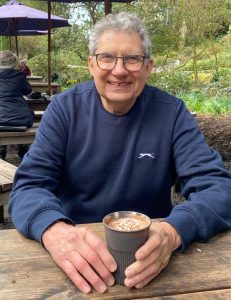
 John Launer is a GP and family therapist, now working as a medical educator and writer. @johnlauner.bsky.social
When I did my first degree in English at Cambridge I had some personal problems, so I went to the student health centre to seek help. They sensibly referred me to a psychotherapist. She was a black woman in her sixties with an American accent called Marie Battle Singer. She lived in a quaint cottage in Little St Mary’s Lane with two spaniels. I knew it was unusual to be a black psychotherapist, but I had no idea how unusual she was in other ways too. Looking her up on the internet decades later, I finally found out about her extraordinary life. I then looked into the histories of two other women she later introduced me to and who had a significant impact on me, Enid Balint and Anneliese Schnurmann. Here, I want to give an account of all three and pay tribute to them
Marie Singer was born in Mississippi in 1910, the granddaughter of a slave. [1] Her family migrated to New York along with many blacks for whom social advancement was impossible in the American south. She did a degree in English literature and a Master’s in social work in Massachusetts, before coming to Europe as a psychiatric social worker. While assisting refugees in post-war Germany, she heard of the work of Anna Freud and wrote to her asking to join the child psychotherapy training at the Hampstead Clinic. She trained as Britain’s first black psychoanalyst, worked part- time as a social worker and completed a PhD at London University. An accomplished painter, she married the Scottish Jewish poet James Burns Singer. Apparently, she used to joke “I won’t tell anyone you’re Jewish if you don’t tell anyone I’m black.”
Like many young patients in psychotherapy, I decided while seeing her that I wanted to become a psychoanalyst myself.
Like many young patients in psychotherapy, I decided while seeing her that I wanted to become a psychoanalyst myself. Rather than dismissing this as a grandiose example of idealisation and transference, she suggested I should go and meet Enid Balint in London to talk about the possibility. I did so, in a grand house in Regents Park. I had no idea that Enid Balint had recently lost her husband Michael Balint, even less that they had set up the GP case discussion groups that bore his name. [2] She took my interest seriously and advised me it would be sensible to train in medicine and become a psychiatrist first, since there were more career prospects for medically qualified psychoanalysts. Perhaps she had it in mind that I was obviously immature, and it would be a test of my motivation.
I now imagine she may also have been influenced by how her medical husband had acquired such eminence, while her own contribution to the development of Balint groups – by all accounts at least equal to his – might have been overshadowed because of her lay background. Either way, it was that conversation that led me to apply for a graduate entry medical course, although in the end I became a GP and family therapist rather than a psychoanalyst.
Marie Singer had suggested that I should find another therapist once I began my medical studies in London. She recommended a woman who had also trained and worked at Anna Freud’s Clinic. She was called Anneliese Schurmann. She was a German refugee and worked from an apartment in Hampstead just round the corner from the Clinic and Sigmund Freud’s house in Maresfield Gardens. By coincidence, it happened to be a few hundred yards from the house my parents lived in by then: they were refugees from Vienna and Prague, and Hampstead had become a magnet for them, like so many from their background. It was also close to the Tavistock Clinic, where the Balints had been based, and where I later did my own therapy training and worked part-time as a consultant in primary care. Given my background, it seems symbolic that so much of my life came to centre on that small patch of London, a kind of ‘shtetl’ for continental Jews, with its unrivalled concentration of couches and cake shops.
She seems to have been especially fond of Susanne’s brother Dietrich, who later became a priest and theologian and was executed for his involvement in an attempt to overthrow Hitler.
Miss Schurmann (as I always called her) was more reserved than Marie Singer, so I learned almost nothing about her while seeing her. But a recent scholarly book about the women who worked at Anna Freud’s Clinic has drawn the curtain back for me on her own remarkable life.[3] She came from a wealthy family of German Jewish industrialists and paper manufacturers. She lost both her parents by the age of eight and was then brought up by her elder sister Leonore, who resisted their guardian’s attempts to remove the two girls from the parental home in Berlin. They remained there instead with the family servants until Leonore married and took the young Anneliese with her into the marital home. Leaving there for university, Anneliese then studied modern languages in Heidelberg and sociology and philosophy at Frankfurt, getting to know leading figures like Theodor Adorno and Paul Tillich. She left for Switzerland in 1937 but finally emigrated to England with two suitcases in 1939. She was wealthy enough to work first as a volunteer at Anna Freud’s Clinic before embarking on training as a children’s therapist and then a psychoanalyst.
For me, one of the most poignant aspects of her story was her connection with the Bonhoeffer family in Berlin. Her closest childhood friend was Susanne, the youngest of eight children of Karl Bonhoeffer, professor of neurology and psychiatry. The family appears to have informally adopted Anneliese as an orphan. Susanne’s diaries are full of accounts of her friend’s involvement in their family life, including Christmas celebrations. She seems to have been especially fond of Susanne’s brother Dietrich, who later became a priest and theologian and was executed for his involvement in an attempt to overthrow Hitler. When asked about Dietrich Bonhoeffer in her eighties, Anneliese’s eyes evidently lit up, “That’s such an old story,” she said. “Those you want, you don’t get, and those who want you, you don’t want! There’s nothing you can do.” Who knows what lay underneath those words?
Although I knew so little about them at the time I met them, it now feels an extraordinary privilege to have encountered these three remarkable women.
References
1. Clare Hall, Cambridge. Marie Battle Singer PhD 1910-1985. Available: https://www.clarehall.cam.ac.uk/marie-battle-singer-ph-d-1910-1985/ (Accessed 24 August 2025)
2. London Remembers. Enid Balint. Available: https://www.londonremembers.com/subjects/enid-balint (Accessed 24 August 2025)
3. Ludwig-Koerner C. The Women of Anna Freud’s War Nurseries: Their life and work. Abingdon: Routledge, 2024.
Featured Image by Joanna Kosinska on Unsplash