

Paul McNamara is a GP in Glasgow and honorary clinical lecturer at the University of Glasgow
Eve Ross-Leahy is a foundation year 2 doctor at the New Gorbals Healthcare Centre, Glasgow
An old man stared out the young boy’s eyes. Deep cracks ran through the quiet courage he tried to hold together. His strained nerves, pushed far past their limits, had begun to leave marks that wouldn’t heal.
I was looking at a twenty-one-year-old whose body had already begun to age under the weight of nitrous oxide.
Nitrous oxide (‘nos’, ‘noxy’) is sold as harmless fun — a party balloon, a legal high, a cheap laugh.
He walked with a stick. His hands trembled when he lifted his water bottle, and his gait had the fragility of someone decades beyond his years. Outside the health centre, the pavement was scattered with the familiar silver canisters — the ones you start to notice everywhere once you know what they are.
He told me the balloons made his mind feel lighter. A short rush. A brief escape. A moment where the noise stopped. But the calm he chased was already taking things from him: sensation, balance, confidence, even the ability to trust his own legs. He didn’t realise he was edging towards damage that might not fully heal.*
Nitrous oxide (‘nos’, ‘noxy’) is sold as harmless fun — a party balloon, a legal high, a cheap laugh. But behind that image lies a growing clinical problem. Use has increased sharply across the UK, especially among young people, where nitrous oxide is now one of the most commonly used recreational drugs.1-5 Cheap, easy to buy online or in corner shops, it’s taken with a casualness that hides how dangerous it can be.
Nitrous oxide causes harm by inactivating vitamin B12, disrupting the conversion of homocysteine to methionine — an essential step in maintaining the myelin sheath.²,⁶ Loss of myelin leads to widespread neurological dysfunction, affecting both the central and peripheral nervous systems.²,⁶ Subacute Combined Degeneration (SACD) of the spinal cord is one of the most severe consequences of nitrous oxide abuse, and the effects can be permanent.⁷
In deep-end general practice, we are increasingly seeing the consequences. Young, otherwise healthy patients come in with symptoms that don’t belong in people their age: pins and needles, heavy legs, numbness, unsteady gait, dizziness.²,⁴,⁵ Many don’t link their symptoms to nitrous oxide. Some are embarrassed. Some are frightened. Many simply don’t know.
A single, gentle question — “Have you used nitrous oxide recently?” — can change everything.
With early intervention, recovery is possible. With continued or heavy use, the damage can be permanent.
Initial investigations include checking serum B12 levels, often low in nitrous oxide toxicity.³,⁶ Depending on the presentation, they may need MRI imaging or inpatient neurological assessment. Treatment is straightforward but time-critical: complete cessation of nitrous oxide and B12 replacement, usually intramuscular.²,⁴ With early intervention, recovery is possible. With continued or heavy use, the damage can be permanent.⁷
Some reports describe neurological symptoms after just one heavy session of nitrous oxide.⁴ What we are seeing now is that these cases are no longer rare outliers — young people with new weakness, numbness, or difficulty walking are starting to appear across primary care and emergency settings.
Emergency departments are reporting increasing numbers of severe neurological injuries linked to nitrous oxide.⁴ Yet public understanding remains dangerously low. The balloons littering parks, bus stops, and alleyways blend into the urban background, but the harm behind them is growing.
As GPs, we are often the first to notice the pattern: symptoms that don’t fit the age of the person sitting in front of us. And we are the ones best placed to intervene early — to ask, to listen, to explain, and to support them through what comes next.
Nitrous oxide misuse doesn’t exist in isolation. It sits alongside trauma, poverty, depression, and the absence of quick or meaningful support. For many young people, balloons offer a moment of silence in a life full of noise.
There is still not enough research into the true scale of nitrous oxide harm in the UK. Case reports are rising, but comprehensive data is lacking. What we do know is that more young people are presenting with nerve damage, more MRI-confirmed SACD, and more long-term disability linked to a drug marketed as harmless.
In practice, the most important question we can ask is often the simplest:
Could this be nitrous oxide?
Early recognition, compassion, and timely intervention remain our best tools. And while the canisters scattered across our communities may seem insignificant, they reflect a warning we can no longer ignore — a generation of young people ageing long before their time.
*Authors’ note: The opening vignette is fictional but reflects real clinical patterns and experience.
Deputy editor’s note: see also – https://bjgplife.com/nitrous-oxide-use-and-health-risks-no-laughing-matter/
References
- Nitrous oxide. Substance Misuse Resources. Nitrous Oxide: Awareness Information and Advice. https://www.substancemisuseresources.co.uk/harm-reduction-information/nitrous-oxide-free [accessed 16/1/26].
- Meng Y, Brown K, Gilchrist A, Thompson A. Rare but relevant: Nitrous oxide and peripheral neurotoxicity. Anaesthesia. 2024;79(6):713–20.
- Garakani A et al. Neurologic, psychiatric, and other medical manifestations of nitrous oxide abuse. Am J Addict. 2016;25(5):358–69.
- Litchfield S et al. Recent surge of nitrous oxide misuse around London. Postgrad Med J. 2020;96:694–5.
- Layzer RB et al. Nitrous oxide-induced myeloneuropathy: a case series. J Neurol Neurosurg Psychiatry. 1978;41:940–6.
- Garakani A et al. Whippits, nitrous oxide and dangers of legal highs. BMJ Case Rep. 2014.
- Patel R et al. Case series of nitrous oxide related subacute combined degeneration 2016–2022. Neurology. 2022;98(18 Suppl).
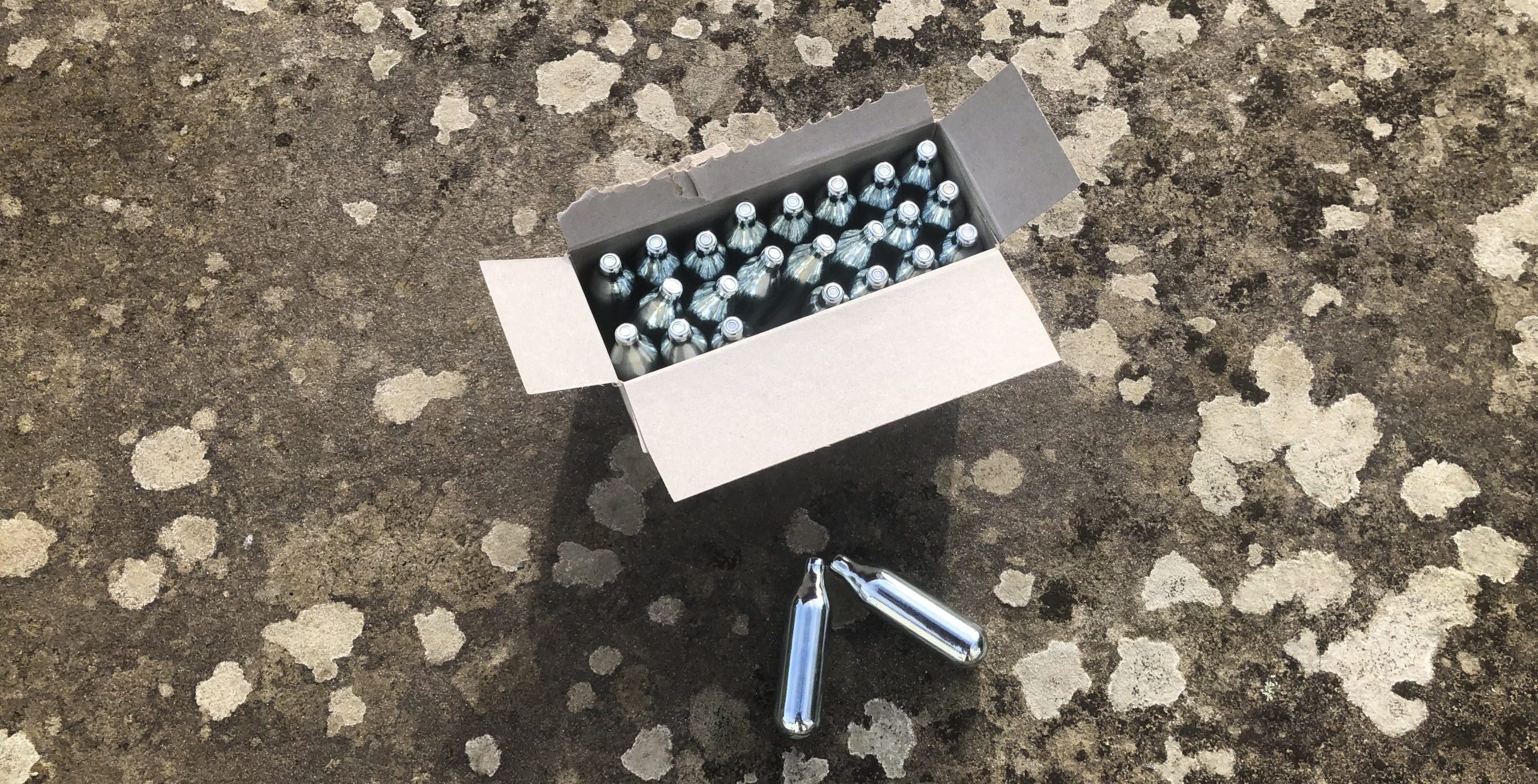
Featured image: Nitrous Oxide canisters sold as propellant for mousse whipping in catering, Photograph by Andrew Papanikitas, 2022