
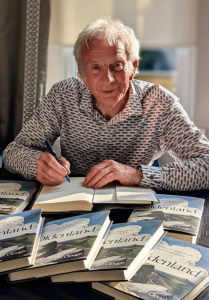
 Roger Clough, a former Professor of Social Care, lifelong hill walker, now resident of Oldenland, reflects on a lifetime of old age research.
Nearly fifty years ago I wrote about people I met in an old age home. Mr. Jepson complained about being made to walk when he wanted to be taken in a wheelchair. A care worker overheard the conversation: “We have to do what the doctor says, what’s for your good,” she said. Other people’s certainties of how best to live in old age.1
In a recent book, Oldenland, through the glasses of an 83-year-old, I contemplate once more the views of how best to grow old: activity or disengagement? striving for independence or seeking help? These reflections lead me to the importance of holding what seem disparate, conflicting goals, what I term competing imperatives.2 I want: to accept the realities of my living (past, present, future) but yet to challenge the assumptions of old age limitations; to encourage myself to keep active but yet to sit back and relax; others to sort my life but yet to make my own decisions; to strive but yet to let go; to move beyond a goal of independence to one of interdependence.
My wife and I moved some years ago to a retirement village – and realise our good fortune in being within walking distance of both GP surgery and urgent treatment centre, facilities that at times we seem to frequent. I reflect on how to present myself as a patient, and what I want from a doctor.
I lie prone, my watch asking whether to call emergency services.
Out walking recently in woods above where we live, territory with rocks slippery from days of rain, I proceed with care. Then, unexpectedly, I crash down, hitting the back of my head on a rock. I lie prone, my watch asking whether to call emergency services. Moments pass, I test body movements, sense that nothing is broken, tentatively get up and take myself back home.
Safely returned, I study the NHS website for information on concussion and decide I have none of the most worrying problems. The next morning, still with a bad headache, it seems sensible to get myself checked out at the minor injuries’ unit, a few minutes’ walk down the road.
I am given a comprehensive check over by the doctor, who takes me carefully through her list of questions. She does this in a way that involves me in a discussion rather than responding to questions from the computer. She asks me about lifestyle, commenting that she has learnt not to presume that older people are no longer involved in work-like activities. I come away not only reassured, but with a sense that I have been treated as a competent adult.
I need the medical expertise, the skills in diagnosis, but want this to lead to a conversation in which choices are opened up.
I find it more difficult to make decisions than in the past, and need more time to explore options. We Oldenlanders ask ourselves what is the best course of action, whether to treat or learn to live with our ailments. A purpose of a consultation is that the doctor, having gathered some evidence, shall give explanation and advice. It is not difficult to realise something of the intimacy, the courtesy and the understanding which is required in this work.3
I realise that what I seek as a patient is a dialogue: I need the medical expertise, the skills in diagnosis, but want this to lead to a conversation in which choices are opened up. Doctors are skilled in painting a picture, presenting us with options, but it is not always easy for us patients to determine what to do. I try not only to cull the wisdom of the doctor, understanding the pros and cons, but to find what they might do in similar circumstances or how they might go about making a decision.
In old age, for as long as possible, I want to chart my way. What I look for from a consultation is the opportunity to understand the nature of the problem, and then, drawing on the knowledge and insights of the doctor, to have a conversation which will help me determine the course of action to pursue.
References
- Clough R. Old Age Homes. London: Allen and Unwin; 1981. London: Routledge; 2022.
- Clough R. Oldenland – A Journey in Search of the Good Last Years. London: John Murray; 2025.
- Spence J. The Purpose and Practice of Medicine. Oxford: OUP; 1960.