


 Richard Armitage is a GP and Honorary Assistant Professor at the University of Nottingham’s Academic Unit of Population and Lifespan Sciences. He is on X: @drricharmitage
12 months ago I used NHS Digital primary care appointment data to reveal the increases in GP workload from 2017 to 2023.1 That analysis revealed that the total number of monthly appointments conducted by GPs increased by 11.7% between December 2017 (approximately 12 million) and October 2023 (approximately 13.4 million). Simultaneously, the total number of full-time equivalent (FTE) fully qualified (excluding those in training) GPs decreased by 5.4% between December 2017 (approximately 28,750) and October 2023 (approximately 27,200), meaning the average number of monthly appointments conducted by each FTE GP in England increased by 18.2% between December 2017 (approximately 417) and October 2023 (approximately 493). Adjusted for the number of working days per month, the average number of appointments per working day by each FTE GP in England increased by 14.8% from December 2017 (approximately 20.25) to October 2023 (approximately 23.25).
12 months on, what has happened to GP workload at the appointment level?
12 months on, what has happened to GP workload at the appointment level? Using trend line analysis, NHS Digital data2,3 reveal that the total number of monthly appointments conducted by GPs in England increased by 2.2% between October 2023 (approximately 13.4 million) and October 2024 (approximately 13.7 million). Simultaneously, the total number of FTE fully-qualified GPs increased by 3.1% between October 2023 (approximately 27,200) and October 2024 (approximately 28,040). The average number of monthly appointments conducted by each FTE GP in England increased by 2.4% between October 2023 (approximately 493) and October 2024 (approximately 505). Adjusted for the number of working days per month, the average number of appointments per working day by each FTE GP in England increased by 2.2% between October 2023 (approximately 23.25) and October 2024 (approximately 23.75). See Figure 1.
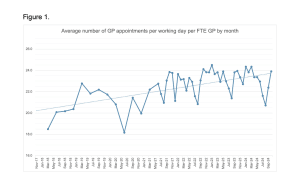
Accordingly, despite the total number of FTE GPs having increased over the previous 12 months, the impact of this has been overwhelmed by the increase in the total number of appointments over the same period. As such, the trend of GPs conducting an increasing number of appointments continues, with the average number of appointments per working day by each FTE GP in England having increased by 17.3% between December 2017 (approximately 20.25) and October 2024 (approximately 23.75).
This trend is while, as discussed last year, the nature of the care provided in general practice continues to become increasingly complex due to a myriad of factors including ageing populations, multimorbidity, polypharmacy, language barriers, and the competence expansion on non-GPs in primary care.4 Accordingly, each FTE GP in late 2024 continues to care for a substantially greater and continuously rising number of patients who are considerably more complex than only seven years previously. This threatens both the quality and safety of patient care, and to the wellbeing of the GPs that provide it. The need to mitigate both this trend and its impacts continues to grow.
References
- R Armitage. Pressure on GPs in England: appointments, workforce, and patient complexity. BJGP Life 31 December 2023. https://bjgplife.com/pressure-on-gps-in-england-appointments-workforce-and-patient-complexity/
- NHS Digital. Appointments in general practice. https://digital.nhs.uk/data-and-information/publications/statistical/appointments-in-general-practice [accessed 29 November 2024]
- NHS Digital. General practice workforce. https://digital.nhs.uk/data-and-information/publications/statistical/general-and-personal-medical-services [accessed 29 November 2024]
- R Armitage. Not helpful but harmful. British Journal of General Practice 01 August 2024; 74(745): 367. DOI: 10.3399/bjgp24X739005