
 Richard Armitage is a GP, MPhil student at the University of Cambridge, and Honorary Clinical Assistant Professor at the University of Nottingham’s Academic Unit of Population and Lifespan Sciences.
[Dropcap]I[/Dropcap]’m about to complete a four-week deployment to Gaza with a British charity that provides medical aid in emergencies worldwide.
This isn’t my first humanitarian deployment. I’ve previously worked with the same charity in Ukraine at the beginning of the conflict there and in Turkey following the 2023 earthquake, as well as with other organisations in Bangladesh, Zambia, and on the Greek island of Lesvos. Each mission has taught me something different about medicine in low-resource settings, but Gaza has presented challenges unlike anything I’ve encountered before.
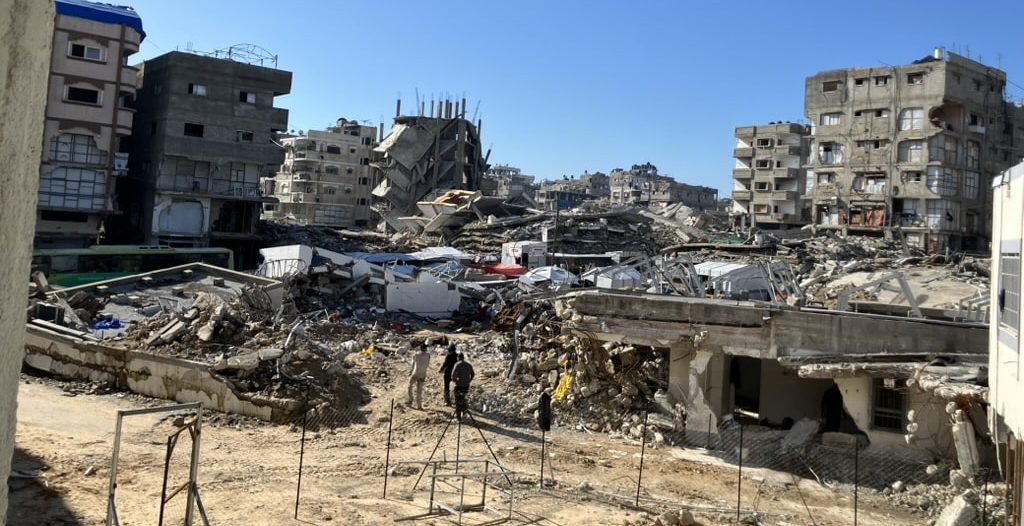
The conflict in Gaza has resulted in the near-total collapse of the healthcare system. As of May 2025, at least 94% of hospitals had been damaged or destroyed, with only 19 of the original 36 remaining operational.1 I’m based in a hospital in Gaza City that sustained severe damage during the conflict. Parts of the facility have recently been recovered and repurposed as a primary healthcare centre, now offering general practice consultations, antenatal care, dermatology, gynaecology, wound care, and basic laboratory services.
As GPs, we know how much we depend on continuity of records; imagine practising effectively and safely without access to any prior information whatsoever.
My role here isn’t clinical. Instead, I’m focusing on capacity building and quality improvement, working alongside Palestinian colleagues to strengthen systems and practices that will endure long after international teams have departed. The doctors here are exceptionally well trained, though many are now working outside their specialisms out of sheer necessity. They are tired. Many have lost loved ones. Yet they continue to show up for their patients, day after day.
A hidden catastrophe: the destruction of digital health infrastructure
Beyond the visible destruction, there is another catastrophe that receives less attention: the elimination of digital health infrastructure. Electronic medical record systems have been destroyed along with the facilities that housed them, erasing detailed health data for an entire population. This creates cascading failures in care delivery that may not be immediately obvious to those unfamiliar with the setting.
Loss of medical records
Digital archives containing patient histories, medication records, and treatment plans no longer exist. Clinicians effectively start from scratch with each encounter, relying on patient recall for medical histories. For patients with non-communicable diseases requiring ongoing management, this loss is particularly consequential. There is no accessible record of previous blood pressure readings, glycaemic control, medication adjustments, or disease trajectory. As GPs, we know how much we depend on continuity of records; imagine practising effectively and safely without access to any prior information whatsoever.
Paper documentation bottleneck
Clinicians write handwritten notes including prescriptions, which are retained by the pharmacy after dispensing. This allows basic data collection on consultation volumes and prescribing practices, but there is no central record for individual patients. Patients receive paper copies, but many lose these due to displacement; much of the population lives in or tent accommodation where document preservation is difficult. Documentation quality is also limited because detailed handwritten notes are time-consuming under substantial patient demand.
Communication failures
Medications and medical equipment are delivered intermittently and are frequently insufficient or entirely unavailable. There is no real-time communication between the pharmacy and prescribing clinicians about current availability. Clinicians prescribe based on clinical indication; patients then often discover at the pharmacy that the medication is unavailable and must source it elsewhere, reducing care quality and placing additional burden on already-struggling patients. While clinicians largely communicate via WhatsApp, frequent power outages and limited cellular reception interrupt this. Referrals to other facilities are paper-based, meaning they are slow, easily lost, and contain limited clinical information.
Antimicrobial resistance: a pre-existing crisis compounded
Much of my work has centred on prescribing quality, especially around antimicrobials. Even before the current crisis, Gaza had extremely high rates of antimicrobial resistance, with studies demonstrating 70% multidrug resistance in wound isolates2 and up to 90% resistance against E. coli isolates.3 Now, with medication shortages, a cold and wet winter, and patients living in overcrowded conditions with limited sanitation, the challenge has intensified.
Antimicrobial prescribing at the facility is unstandardised, reflecting an absence of locally-adapted guidelines that predates the conflict. Clinicians lack accessible decision support for antimicrobial selection in this high-resistance, resource-constrained context. Additionally, some clinicians are working outside their usual specialty due to workforce displacement and infrastructure destruction, increasing the value of clinical decision support tools. I’ve helped to develop prescribing guidelines tailored to what medications are actually available and local resistance patterns, alongside training sessions on antimicrobial stewardship and common primary care presentations.
Reflections
The living conditions for the population here are extraordinarily difficult. Many patients come to us from tents, having endured harsh winter weather in recent weeks. Food supplies have mercifully improved, but the cumulative toll of prolonged hardship is evident in every consultation.
Food supplies have mercifully improved, but the cumulative toll of prolonged hardship is evident in every consultation.
What has struck me most, however, is the warmth of the staff we work alongside. Despite everything they have endured, they have welcomed us as colleagues and collaborators. There is a shared understanding that we are all here for the same reason: to strive to provide the best possible care to people who need it.
My colleagues have been tackling equally fundamental issues: establishing safe medical waste disposal, connecting the clinic with local mental health services, and training nursing and non-clinical staff in triage. This might sound like basic work, the kind of thing we take for granted at home. But when a health system has been so severely disrupted, rebuilding starts with foundations.
I’m grateful for the opportunity to contribute, however modestly, to the healthcare response here. When I return home, and to clinical practice in the NHS, I’ll bring with me a deeper appreciation for the people who sustain healthcare in the most challenging circumstances imaginable, and for the digital infrastructure that underpins the care we provide every day.
References
1. World Health Organization. Health system at breaking point as hostilities further intensify in Gaza, WHO warns [Internet]. 2025 [cited 2026 Jan 16]. Available from: https://www.who.int/news/item/22-05-2025-health-system-at-breaking-point-as-hostilities-further-intensify–who-warns
2. Moussally K, Abu-Sittah G, Gomez FG, Fayad AA, Farra A. Antimicrobial resistance in the ongoing Gaza war: a silent threat. The Lancet [Internet]. 2023 Nov [cited 2026 Jan 16];402(10416):1972–3. Available from: https://linkinghub.elsevier.com/retrieve/pii/S0140673623025084
3. El Aila NA, El Aish KIA. Six-year antimicrobial resistance patterns of Escherichia coli isolates from different hospitals in Gaza, Palestine. BMC Microbiol [Internet]. 2025 Aug 29 [cited 2026 Jan 16];25(1):559. Available from: https://bmcmicrobiol.biomedcentral.com/articles/10.1186/s12866-025-04335-3
Featured Photo by Richard Armitage, 2026