


 Andrew Papanikitas is Deputy Editor of the BJGP.
There is an Icelandic tradition, Jolabokaflod (Christmas book flood), which began during World War Two once Iceland had gained its independence from Denmark in 1944. Paper was one of the few commodities not rationed during the war, so Icelanders shared their love of books (other gifts were in short supply). By tradition, gifts are opened on 24 December and everyone reads the books they have been given straight away, often while drinking hot chocolate or alcohol-free Christmas ale called jolabland.1 For the last couple of years we’ve also had a BJGP tradition of reviewing some book-ish stocking fillers, books to give to those we love (and/or work with), books to read in quiet moments and on cold nights, and books to talk about at gatherings.2,3 It’s been another bewildering year on both a global and local level, and the selection reviewed reflects this.
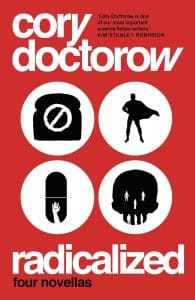
Radicalized: Four Novellas, by Cory Doctorow
No haunting season is complete without ghost stories. Radicalized, a collection of four novellas by Cory Doctorow is not about supernatural entities (or ghosts of the past) but a haunting and darkly humorous series of reflections for (ghosts of) a near future dominated by powerful interests via technology. In Unauthorized Bread we see America through the eyes of a refugee trying in earnest to become a US citizen with her son. In this particular dystopia, however, household appliances will only work with appropriately branded products — the toaster oven will only cook authorised bread. In Model Minority we are invited to imagine what might happen if an alien superhero chose to defend the innocent and vulnerable in direct conflict with the government. In Radicalized we see grieving parents declare war on commercial health insurance. In Masque of the Red Death a wealthy businessman builds a luxury refuge so that he and some chosen friends can sit out the apocalypse. Bleak though these stories are, they also offer hope. Buyer beware.
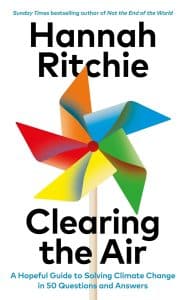
Clearing the Air: a Hopeful Guide to Solving Climate Change in 50 Questions and Answers, by Hannah Ritchie
Hope can come in a simultaneously optimistic and realistic book that offers 50 bite-sized chapters answering all those annoying questions about climate catastrophe. Won’t energy workers lose jobs in the transition to greener energy? Don’t wind farms kill lots of birds? Isn’t nuclear power dangerous? Aren’t electric cars just as bad for climate as petrol cars? Meat substitutes are ‘ultra-processed’; doesn’t that make them unhealthy? What about AI? And what did Mr Bean actor Rowan Atkinson write that caused conniptions among energy analysts? There are useful, data-driven, but pithy and readable answers to all these questions and many more. My main conflict of interest in reviewing this book is wanting a world that my children and grandchildren will be able to live in, ideally without having to kill their neighbours for food. If you want to see how that could play out, read The Wall by John Lanchester.4
Brandolini’ s law states that the amount of energy needed to refute bullshit is an order of magnitude greater than that needed to create it. This is a bullshit-antidote of a book to supercharge conversation, shape lifestyles, and inform our commercial and political choices. It is certainly interesting to see reasonable climate-based arguments for both nuclear power and artificial intelligence.
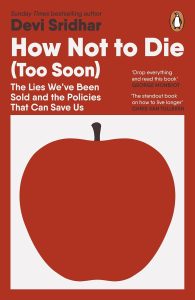
How Not to Die (Too Soon): the Lies We’ve Been Sold and the Policies That Can Save Us, by Devi Sridhar
This book is marketed as ‘The lies we’ve been sold and the policies that could save us’, but I really do not think that this does the book (which I couldn’t put down until it was finished) justice. It is part memoir, part manifesto, but a compelling and clear discussion of the public health that should matter to us all — the things that will unjustly shorten our lives, and the things that help us live longer, healthier ones. It is nice to know that in the UK we get some things right: we live longer because we don’t have widely available guns, smoking is banned from public spaces, and we have a national health service, paid for by taxation and free at the point of use. We can always do better, of course, and learn about food culture from Japan and traffic safety from the Netherlands, for example. Public health is not, we have been told so many times, just about infectious disease. This book will make you angry and sad — I struggle to understand how importing air by the cylinder from Canada (this is a thing) is better than pushing for clean air legislation. It will also make you hopeful. There are plenty of examples of individuals and groups (often motivated by a tragedy) shifting the dial on public health policy — I found myself silently cheering! However, there are also things we can do for ourselves and for each other to help more of us live longer, healthier lives. The chapters on exercise and food are obvious places to start — just do it.
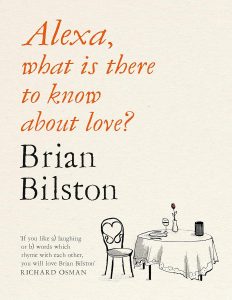
Alexa, What is There to Know About Love?, by Brian Bilston
The Alexa referred to here, for the benefit of those who have been hiding under a rock (and who would blame you), is the cloud-based voice interface for Amazon devices. I regard Brian Bilston and his (bitingly) humorous poetry as something of a national treasure. Apart from the titular poem during which I nasally exhaled a coffee, I was somewhat shaken by a wonderful ‘concrete’ poem that takes the shape of its subject: Tsundoku — the act of acquiring reading materials but letting them pile up in one’s home without reading them! Poetry is for life, not just for Christmas. Bilston has (of course) written a Christmas collection, which makes an enlightened ‘secret Santa’ offering. However, Alexa, What is There to Know About Love? is a perennial treat that might be prescribed (and cautiously — or, given the context, confidently given) to colleagues who have never ‘got’ poetry.
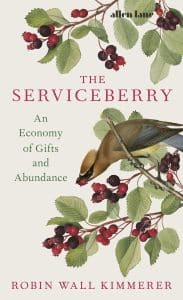
The Serviceberry: An Economy of Gifts and Abundance, by Robin Wall Kimmerer
Do you ever buy a book for someone else and then ‘accidentally’ read it from cover to cover before you part with it? The Serviceberry is an inspiring and uplifting (and subtly festive) introduction to the work of Robin Wall Kimmerer, indigenous American ethnobotanist and author of Braiding Sweetgrass. The book is an extended reflection on the abundance and reciprocity in nature, taking the serviceberry, a berry native to the author’s home, as its case study. The serviceberry lies at the heart of a natural ecosystem and a human gift economy — it is wild and abundant — an economy that fosters the plant’s own survival. In a gift economy, the currency in circulation is gratitude and connection, rather than direct exchange. Kimmerer discusses ancient and modern gifting and sharing traditions in North America, with beautiful illustrations by John Burgoyne. I was taken by the indigenous American rules of the ‘honorable harvest’, which begin, ‘Know the ways of the ones who take care of you, so that you can take care of them.’
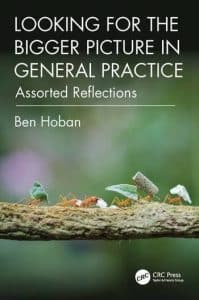
Looking for the Bigger Picture in General Practice: Assorted Reflections, by Ben Hoban
If you want to inject magic and wonder into being a GP then this book presents a very fun New Year’s resolution that’s good both for professional practice and the soul. I am (very literally) conflicted in writing about, and full-heartedly recommending, this new book, but only because it started here, in the BJGP. The articles collected in this volume have, for the first time, been revised and curated (with linking text) into four sections: how we think about things; how the system works; how we look after patients; and how we look after ourselves and each other. The articles in this volume made me laugh (out loud), swear (quietly), and think (a lot). Non-GPs reading this may also get a sense of what general practice is and what it ought to be — I think that ‘One Big Thing’ should be sent to all politicians with a mandate that affects general practice.5 This book sits alongside the works of Iona Heath, John Launer, and David Misselbrook as a miscellany of professional wisdom. Comprising reflections, provocations, satire, and even a ghost story (The Deal), this volume is a companion for both the coffee break (if you get them) and the fireside.
References
1. Jolabokaflod. Founding story. https://jolabokaflod.org/about/founding-story (accessed 24 Oct 2025).
2. Papanikitas A. Five book-ish stocking fillers. BJGP Life 2022; 24 Dec: https://bjgplife.com/five%C2%A7-woke-ish-stocking-fillers (accessed 6 Nov 2025).
3. Papanikitas A. Five stocking fillers for the woke GP. Br J Gen Pract 2024; DOI: https://doi.org/10.3399/bjgp24X740133
4. Papanikitas A. Three novels for planetary health. Br J Gen Pract 2023; DOI: https://doi.org/10.3399/bjgp23X734901
5. Hoban B. One Big Thing. Br J Gen Pract 2024; DOI: https://doi.org/10.3399/bjgp24X736881
Featured photo by Aaron Burden on Unsplash.

You really need to include some classics and recent books. For example, A Fortunate Woman by Polly Morland is a wonderful, modern view of country practice and family life. Follows on A Fortunate Man respectfully but expands and enlightens.
We have actually reviewed the book you mentioned twice: here https://bjgplife.com/a-fortunate-woman-is-a-skilfully-upbeat-offering-for-less-fortunate-times/ and here: https://bjgplife.com/fortunatew/