

 Ben Hoban is a GP in Exeter.
At a time when healthcare systems are struggling, it is easy to recognise the practical difficulties posed by ageing populations, inadequate infrastructure, and high professional turnover. At a deeper level, though, it is clear that we are in the middle of a crisis, not just of practicalities, but of meaning: underlying many of our day-to-day struggles is the larger struggle to make sense of our experience and to present that experience in ways that also make sense to others.
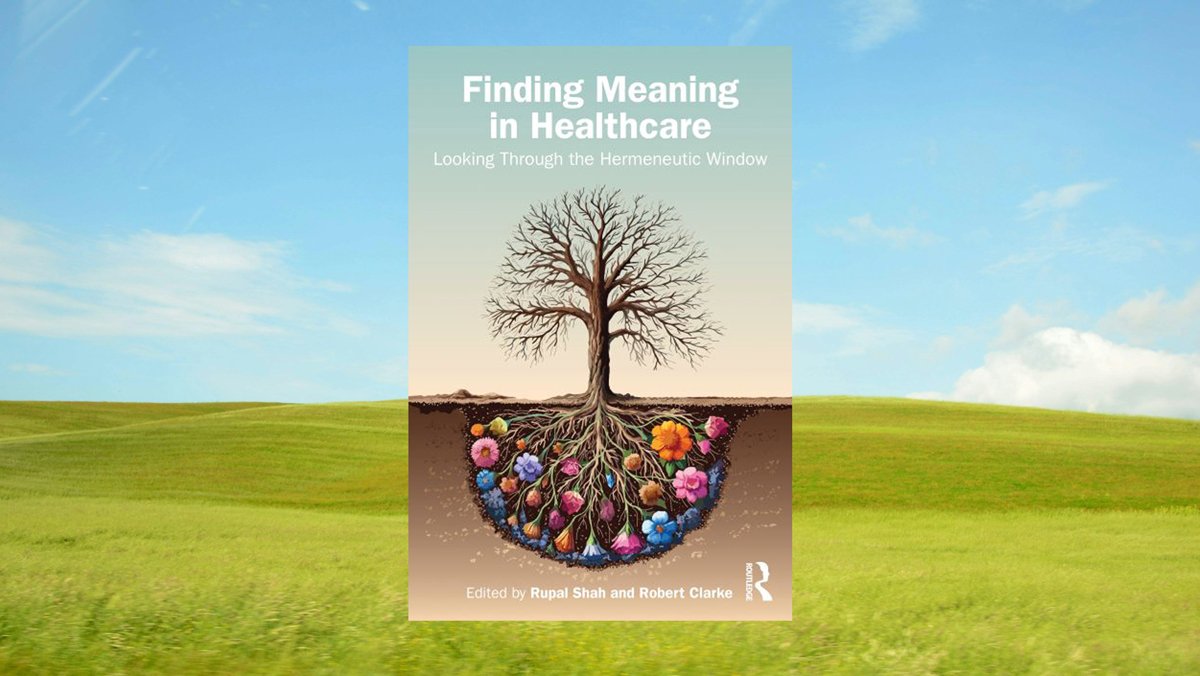
Patients often do not feel heard and their doctors are tired of constantly being told to do more; general practice as a profession must tug at the sleeve of power to explain exactly what it is that we already do, how it differs from what specialists and other non-generalists do, and why that difference matters. Finding Meaning in Healthcare: Looking Through the Hermeneutic Window examines this bigger picture. It is edited by Rupal Shah and Robert Clarke, who, together with Sanjiv Ahluwalia and John Launer, previously introduced the idea of the ‘hermeneutic window’ in the consultation.1 It includes contributions from a total of 22 writers, the majority of them past or present GPs, alongside educators, academics, and others with relevant experience.
“… general practice as a profession must tug at the sleeve of power to explain exactly what it is that we already do …”
I suspect that most of us would not until now have included defining the word ‘hermeneutic’ in the inventory of our daily struggles, and perhaps that is partly the point. We happily prescribe many varieties of little white pill without being able to explain precisely how they are manufactured or work, and in the main, patients are happy to take them. When general practice is under intense and continuous pressure to justify its very existence, though, how can those of us who are not academics articulate its finer points? We surely have enough to do already without worrying about theory. Sabena Jameel, one of the book’s contributors, acknowledges the need to persuade ‘busy clinicians that these ideas are still relevant, rather than making them feel alienated and uninterested.’ (p. 121). Finding Meaning in Healthcare succeeds not just in setting out the theoretical basis for what we do as GPs, but in doing so in a way that keeps the focus on day-to-day patient care. It is easy to lose sight of how much we do, to be worn down by constant criticism and demand, and this is a book to remind us that we have a unique and valuable role.
The idea of the hermeneutic window is in fact very straightforward: just as we make use of evidence-based practice and clinical and communication skills in our consultations, we also apply hermeneutics whenever we interpret something. The need to find and create meaning is the lens, or window, through which we regularly examine our patients’ stories, not just to fix a problem, but to help someone who is suffering make sense of what is happening. This is a distinction to which the authors regularly return. Rupal Shah and Robert Clarke point out in their introduction: ‘It appears to us that suffering is not permissible within our current healthcare paradigm.’ (p. 4). In other words, you can have a problem that needs to be fixed, and we’ll do our best to fix it, but please don’t go dragging your messy, complex, unfathomable suffering through my waiting room! Jens Foell and Sami Timimi elaborate the point:
‘In the everyday world of emotional turbulence, the temptation to step away and retreat from this maelstrom into the embodiment of the scientist-technician is understandable. We want to suggest that such a solution may appear to provide short-term relief for the professional but may actually make your job as a doctor more difficult in the long run. … Sometimes when we stop trying so hard to be the possessors of cure knowledge and “let go” of our expectations of ourselves as doctors, we relate in a way which has more potential to be therapeutic.’ (p. 43).
“… we can often achieve more and feel better by letting go a little, by being rather than doing, and by listening.”
I think that most of us would prefer a less transactional, more humane way of working, but feel constrained by a lack of time and the constant pressure to be doing something. There are only so many screen alerts you can ignore, after all, and curiosity can start to feel like a liability rather than a key to unlock the reason someone has come to see us; it may just feel easier to leave that door closed. The wonderful, joyful, and open secret of general practice, though, is that we can often achieve more and feel better by letting go a little, by being rather than doing, and by listening. As John Launer and Louise Younie put it, ‘Every person’s story contains its own momentum for change: good listening and questioning can facilitate this, not by explanation and persuasion but by allowing space for it to develop.’ (p. 104).
It is entirely appropriate that we should concern ourselves with hard outcomes, and it is clear from the evidence that where these can be improved by health care, the most important factors are sometimes less concrete than we might assume.2 It is indisputable that continuity of care matters, for example, and in a similar vein, Jens Foell and Sami Tamimi argue that ‘our choice of hermeneutic scaffolding will have a bigger impact on patient level outcomes than our choice of technical interventions.’ (p. 42). The dominant paradigm within health care is now one of neoliberal market efficiency, of anonymous systems operating through rigid sets of rules to eliminate disease, and in order actually to care for patients, it has become necessary to rebel against it and ‘transform healthcare from an industrial activity to a deeply human one that provides careful and kind care for all.’ (p. 146). Jane Myat and Jane Riddiford go on to say, ‘To care is to pay attention, to see, to listen, to feel. Care becomes compassion when we connect with the joy and suffering of others because we realise: there is no “other.” We are all interconnected.’ (p. 147).
There are clear threads that run through this book — humanity, relationships, narrative — although each chapter also has its own focus, such as complex multimorbidity, mental health and chronic pain, ethics, social justice, artificial intelligence, leadership, and medical education. It therefore combines depth with breadth, although at 178 pages it is not a long read; for those who want more there is also a Finding Meaning in Healthcare podcast.
It can often feel as if much of the work we do as GPs is either undervalued, misunderstood, or downright invisible. This book provides a wealth of testimony and ideas that equip us to care more effectively, thrive more easily, and demonstrate to ourselves and others exactly what it is that makes general practice so worthwhile.
Featured book: Rupal Shah and Robert Clarke, Finding Meaning in Healthcare: Looking Through the Hermeneutic Window, Routledge, 2025, PB, 178pp, £29.99, 978-1032832166
References
1. Shah R, Clarke R, Ahluwalia S, Launer J. Finding meaning in the consultation: introducing the hermeneutic window. Br J Gen Pract 2020; DOI: https://doi.org/10.3399/bjgp20X712865.
2. Sandvik H, Hetlevik Ø, Blinkenberg J, Hunskaar S. Continuity in general practice as predictor of mortality, acute hospitalisation, and use of out-of-hours care: a registry-based observational study in Norway. Br J Gen Pract 2022; DOI: https://doi.org/10.3399/BJGP.2021.0340.
Featured photo by javs lopez on Unsplash.


Hey, just found this super simple online tool called “White Screen.” I’ve been using it to get better lighting on my Zoom calls – just pull it up fullscreen and it acts like a mini ring light for my face. Also great for when I need to temporarily focus on a document without desktop distractions. Super handy little lifesaver!
Hey, just pulled the best prank on my friend who’s always on their Chromebook! Used this super realistic fake Chrome OS update screen. They totally thought it was frozen and started freaking out. 😂 Perfect for when you need to mess with someone who’s a little too glued to their screen. It’s free and looks exactly like the real thing!