
Crispin Fisher is a GP partner at Ryeland Surgery, Leominster.
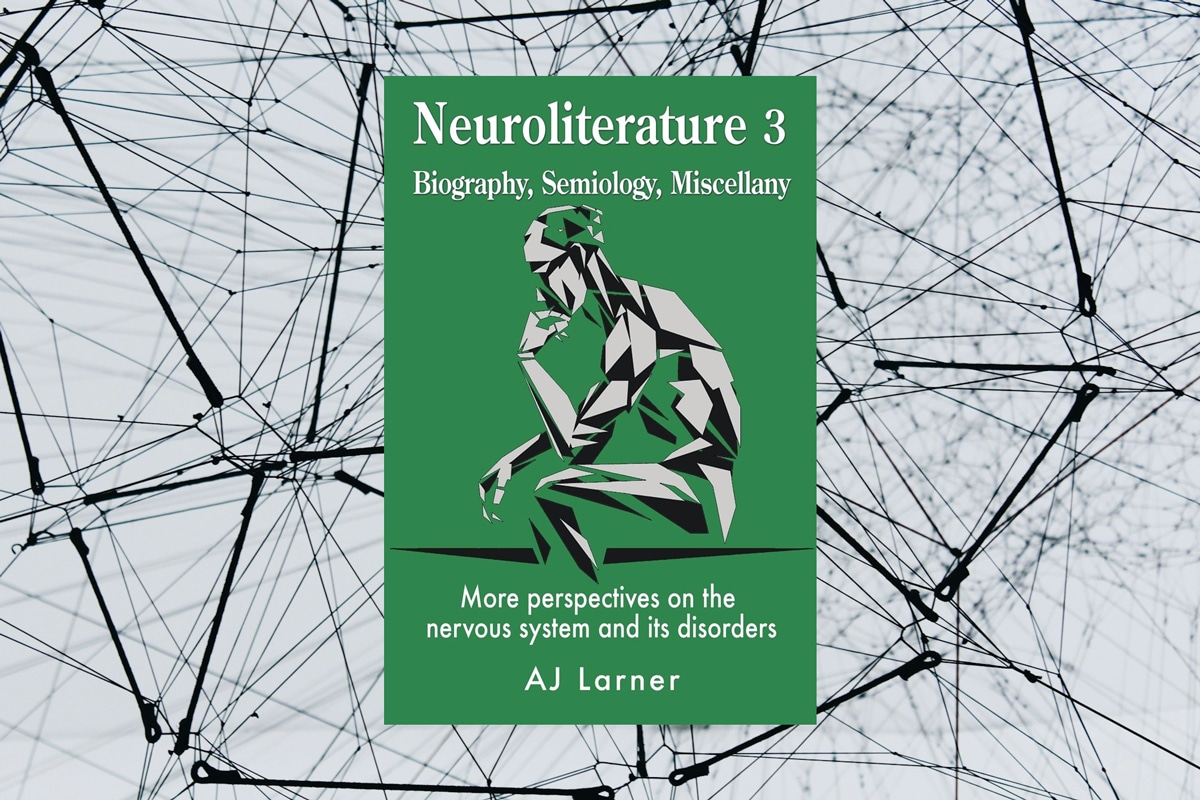
This is the third (and final) volume of Neuroliterature by Andrew Larner, a recently retired neurologist and cognitive expert at the Walton Centre for Neurology and Neurosurgery in Liverpool. It proves to be a veritable treasure chest of mostly short and accessible articles. It is clear that alongside his clinical career, Larner has a passion for medical history. (He was an examiner for the Society of Apothecaries History of Medicine course and former editor of the Journal of Medical Biography).
The reader can pick up this volume and read any chapter in its own right. Divided into sections of biography, semiology, miscellany, and book reviews, there is much to fascinate, intrigue, and, on occasions, amuse the reader.
He muses on the nature of medical biography itself, with reference to liminality (a concept every thoughtful doctor should ponder), and on ‘retrodiagnosis’, or posthumous diagnosis, including its ethical implications, referencing Nietzsche’s diagnosis of frontotemporal dementia (rather than neurosyphilis as previously thought) and Agatha Christie’s episode of functional amnesia. There are essays on the value of case reports, on prosopography versus biography, and the author turns medical detective in identifying the true identity of patients ‘Quaerens and Dr Z’ in case reports by John Hughlings Jackson, the foremost English neurologist of the late 19th century.
“Whether or not they are familiar with the term semiology, all clinicians will enjoy the variety on offer from Larner.”
Among the biographical nuggets we learn about Robert Wilfred Skeffington Lutwidge, a barrister who became ‘Commissioner in Lunacy’, in which role he came to an untimely end when attacked with a nail by an inmate of an asylum. Robert was uncle to the better-known Charles Lutwidge Dodgson (aka Lewis Carroll). Any who are not familiar with the life of Hungarian doctor Ignaz Semmelweis would do well to read of his endeavours. The amazing work of David Ferrier in stimulating anaesthetised animals’ brains is described, allowing localisation of motor functions in the cerebral cortex. Elsewhere a case is made that the eponymous disease of Arnold Pick, professor at the German University in Prague, should now be laid to rest.
Whether or not they are familiar with the term semiology, all clinicians will enjoy the variety on offer from Larner. There is a summary of medical eponyms deriving from literature and the arts, including Don Quixote, Alice in Wonderland, Godot, and Mona Lisa syndromes, and Lilliputian hallucinations. Are we all familiar with Kernohan’s notch? Or the flamingo test (standing on one leg for 10 seconds) as a predictor of survival, surely one GPs should elicit regularly? We learn the history of the jaw jerk and the dubious value of auscultating the skull (over the orbits) to identify arteriovenous malformations. A new medical term is proposed, migramnesia, to denote the association of amnesia with some episodes of migraine. Personification is described, the naming of paralysed or otherwise debilitated limbs by their owners (‘Toby’, ‘Silly Billy’, and ‘Floppy Joe’). Would we recognise Pisa syndrome (lateral curvature of the spine)? Or the intricacies of the Romberg sign (and its spelling — no ‘h’).
The miscellany section is aptly named. Neurological references in the world of literature include Hilary Mantel’s akathisia, possible Brueghel syndrome in Kafka’s The Trial, and severe headache in Charles Reade’s novel Hard Cash. How many know that Dumfries lays claim to the first surgical use of anaesthesia in Europe?
This is just a selection of what is on offer in this eclectic volume. Those who want to learn more about literary portrayals of neurological disorders (including by Austen, Dickens, and Conan Doyle), as well as further biographical pieces, considerations of semiology in clinical medicine, and more miscellany can reach for Neuroliterature 2 (2023) and Neuroliterature: Patients, Doctors, Diseases (2019).
Featured book: Andrew J Larner, Neuroliterature 3: Biography, Semiology, Miscellany. More perspectives on the nervous system and its disorders, The Choir Press, 2025, PB, 260pp, £16.95, 978-1789635294
Featured photo by Alina Grubnyak on Unsplash.