
 Terry Kemple is a retired GP in Bristol, England, and has various roles promoting greater sustainability in general practice including as Director for the Royal College of General Practitioners (RCGP) Green Impact for Health Toolkit. He is a past President of the RCGP.
In meetings and presentations many people struggle to get their message across clearly. It’s a bad experience for them but also for their audience.
In the early 1990s I felt that general practice lacked influence and importance in the NHS because GPs were often poor communicators at meetings. As a result, the Royal College of General Practitioner’s Severn Faculty organised and subsidised an expensive training course in public speaking. While that short course did not make us the best public speakers, it did raise our standards and interests.
“… I felt that general practice lacked influence and importance in the NHS because GPs were often poor communicators at meetings.”
In 2014, Bill McGowan wrote a book called Pitch Perfect: How to Say It Right the First Time, Every Time. It gave advice on how to be a great communicator in different situations.
By 2025, things have changed. There are new ways to meet and to present, more sensitivities to consider, and better understanding of what works well when communicating. W Edwards Deming, an expert in quality improvement, said, ‘It’s not enough to do your best. You must know what to do, and then do your best’. This new book is designed to help you do that; to know what works in communication and advise how to do it well.
McGowan and Juliana Silva are communication experts who help people find their distinctive voice, improve how they speak, and present their ideas.
They provide simple and practical advice. They break down the key parts of good communication, such as:
- telling a clear and connected story;
- using storytelling to make your point;
- creating a few powerful and memorable lines;
- using the ‘Magnificent Seven’ tools to make your message stick;
- avoiding boring, slide-by-slide presentations;
- being warm and approachable;
- using your voice expressively; and
- using body language purposefully.
Their ‘Magnificent Seven’ are seven techniques that help your ideas stick in people’s minds for a long time:
1. Analogy/metaphor — comparing something to something else to explain it. But always avoid the bad analogy (‘banalogy’) that falls flat, such as ‘a bad attitude is like a flat tyre. Until you change it, you can’t move forward’.
2. Creative label — giving something a catchy name. For example, the ‘Big Goodbye’: this is where you avoid a person all night and then when it’s time to leave, you go, ‘Hey!’ and you give them a big goodbye and they feel good, they’re very happy that you spent this time with them at the end of the night and then you slip out. Another is ‘Slide Karaoke’: when the style of presenting is one where every word on the slide is read by the presenter.
3. Twisted cliché — putting a new spin on a familiar phrase. Newspaper headlines do this regularly.
4. Wordplay — using clever or playful language. For example, Michelle Obama said: ‘When someone is cruel or acts like a bully, you don’t stoop to their level. No, our motto is: “When they go low, we go high.”‘1
5. Data with context — sharing facts and numbers in a meaningful way. For example, a data streaming speed of 100 megabits per second means little to most people unless you say it’s downloading a high-definition movie in 3 minutes.
6. Original definitions — creating your own definitions to explain ideas. For example, what does ‘energy’ in the context of public speaking really mean? ‘Energy is your visible enthusiasm for the value of the information you’re sharing.’
7. Mathematical equations — using simple formulas to make your point. A mathematical equation can be either an equation using addition, or a ratio, like ‘the more memorable your communication, the more impact you have.’
“If you learn nothing else, they give good advice about what you should always avoid when speaking in front of any audience.”
One chapter focuses on how women can best manage the situation when they express an opinion or put forth an idea, and men, either intentionally or unwittingly, undermine them. They give four ways this can occur: mantimidation, mansplaining, manterrupting, and theftosterone. Other chapters cover humour, Zoom-type meetings, and how artificial intelligence is changing our communication.
If you learn nothing else, they give good advice about what you should always avoid when speaking in front of any audience.
These are tools anyone can learn and use. Working on all these areas and doing them well should improve your communication and help your ideas get heard and remembered.
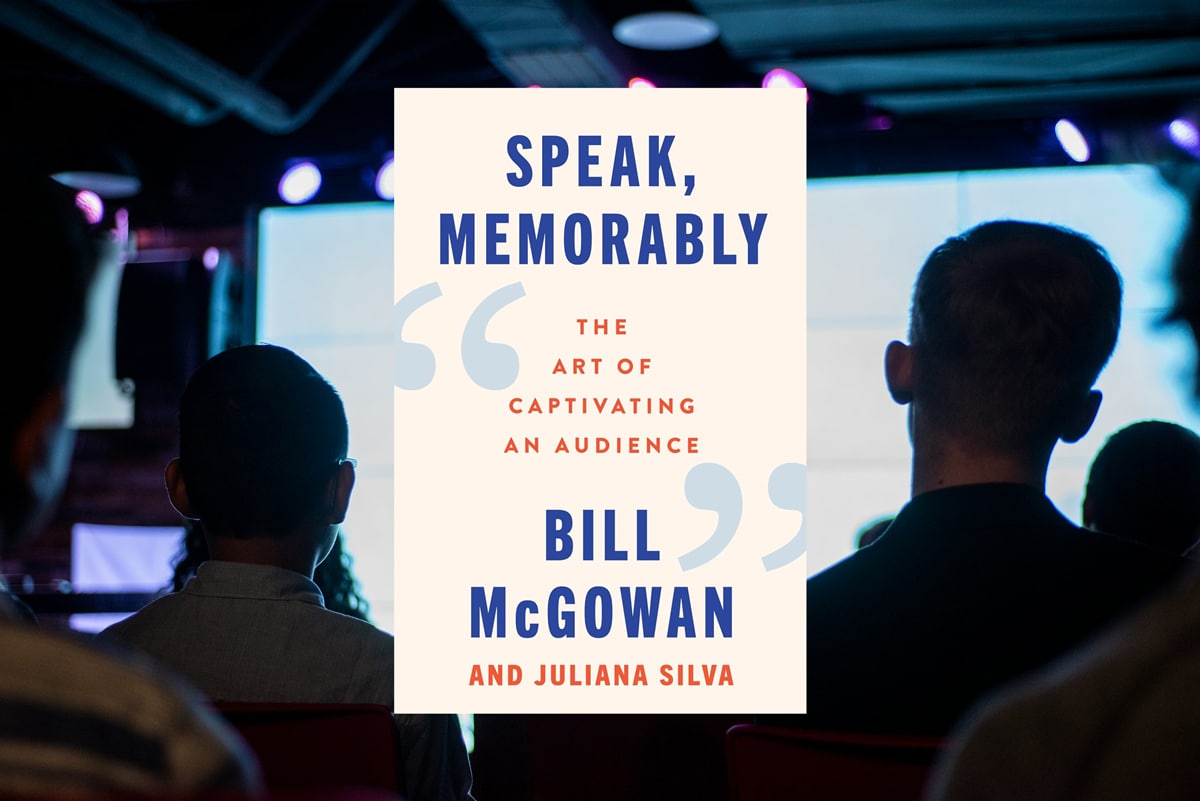
Featured book: Bill McGowan, Juliana Silva, Speak, Memorably: The Art of Captivating an Audience, Harper Business, 2025, HB, 272pp, £25.00, 978-0063415195
Reference
1. PBS NewsHour. First lady Michelle Obama on bullies: ‘We they go low, we go high’. YouTube 2016; 26 Jul: https://www.youtube.com/watch?v=La-q0c02aLU (accessed 5 Aug 2025).
Featured photo by Kevin Gonzales on Unsplash.