 Andrew Papanikitas is Deputy Editor of the BJGP.
I am not usually a fan of self-published books. Self-publishing or paying a commercial publisher to host your work electronically in print often comes at a cost in editorial quality, whether the deficit is in the argument or the typography. This elegant little volume bucks that trend. Though is ostensibly published by the author and printed in the UK by Amazon, with financial support from the Dr Prem Nath Berry Educational Trust, it is well put together. I really liked this book. It is accessible, engaging and has important ideas to share.
Sokol has (the foreword tells us) combined three elements over a career: Historian, Ethicist, and Barrister (specialising in clinical negligence). This book emerges from that convergence.
I first got to know Daniel Sokol’s work from his helpful and often entertaining column in the British Medical Journal (BMJ). In teaching, I frequently recommend these articles on topics ranging from truthfulness to futility. I was rather disgruntled that he had obtained from the BMJ the nom-de-plume, ‘Ethics Man.’ This was partly jealousy and partly my acquiring the less flattering medical school nickname, ‘Ethics-Boy.’ Sokol has (the foreword tells us) combined three elements over a career: Historian, Ethicist, and Barrister (specialising in clinical negligence). This book emerges from that convergence. It is in two parts, and I consider them both worth reading (I read them in two sittings, and the book has gone into my notional reference-shelf). Since medical school I had taken Sokol’s Applied Clinical Ethics course at Imperial college and heard him speak on topics as diverse as medical honesty and military ethics. This broad engagement with professional medical ethics in the UK and beyond is very much distilled through his writing.
This of course means that the reader must take everything I say with a healthy dose of scepticism due to my abundance of benevolent prejudice (bias)! I should add that as someone who teaches ethics to undergraduate clinical students and to qualified clinicians, I am somewhat invested in what Sokol has to say.
The book is in two parts. The first part is the five essential lessons from teaching clinicians in trouble (each gets a chapter). These are ostensibly distilled from working with hundreds of clinicians who have found themselves in trouble with the law or their institutions. Sokol also observes that many of the courses provided at medical school and in the postgraduate setting serve such students poorly. The lesson headings are:
- Make medical ethics education a priority
- Clinicians must recognise their power
- Clinicians must be scrupulously honest in and out of work
- Seek help from others
- Medicine is not ‘just a job’
These lessons, as Sokol unpacks them, ring true. When I conducted research on ethics education for my own PhD, I was surprised to discover the ethical tokenism he alludes to, as well the lack of engagement with ethics by learners in medical education.
These [lessons] are ostensibly distilled from working with hundreds of clinicians who have found themselves in trouble with the law or their institutions.
The second part of the book is in essence, ‘An introduction to Osler.’ It comprised a short biographical summary of Osler’s life and medical career, followed by a curated collection of Osler quotations for a variety of purposes. Themes include lifelong learning, clinical observation, empathy, work ethic and fulfilment.
Many of my contemporaries will recognise many of the names he drops. He has for most of his professional life been around medics, taught medical students, writing in medical journals and involved in learned medical societies. For those who have yet to join Osler Club for dinner at the Royal College of Physicians, there is still a purpose to the namedropping: ‘Don’t take my word for it,’ he appears to say, ‘But listen to all my learned friends, your seniors and peers, as well.’
The way in which Sokol encapsulates both his and Osler’s wisdom in his own storied journey and the shared wisdom of medical colleagues is very appealing. I feel like part of a community as I read the book, and as suspect that teachers and learners of professionalism and ethics in medicine may also feel this way. This is a fantastic book (pocket sized) to take on a journey or to the beach, or keep in a desk drawer for that time when Oslerian wisdom might come in handy.
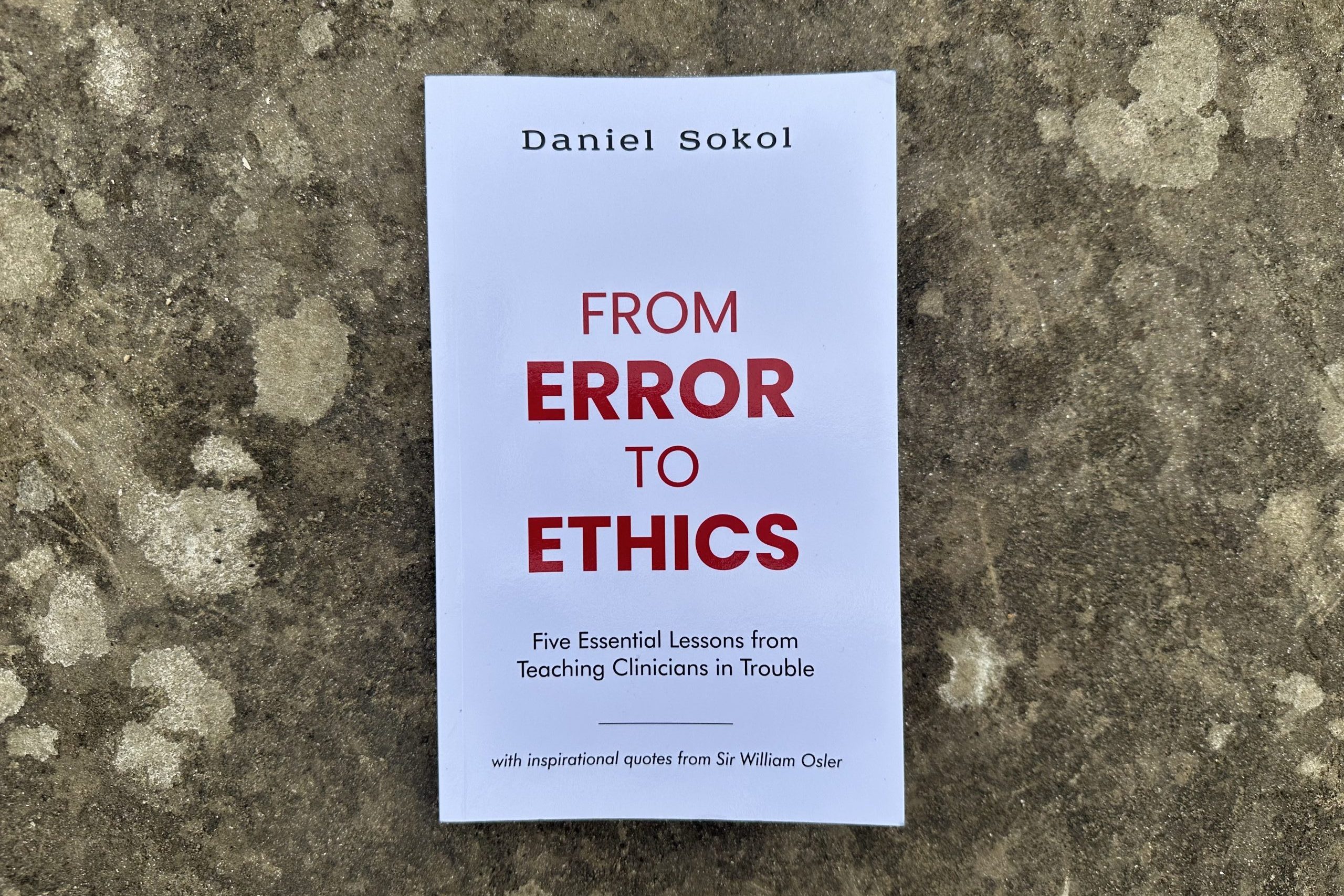
Featured book: Daniel Sokol, From Error to Ethics: Five essential lessons from teaching clinicians in trouble: with aspirational quotes from Sir William Osler, 2025, Published by Daniel Sokol, ISBN 978103691423, 106 pages, Paperback, £9.99 (£6.99 on Amazon Kindle)
Featured photo taken by Andrew Papanikitas, June 2025