

 David Zigmond served as an NHS psychiatrist and Principal GP from the 1970s. In retirement he now works as a psychotherapist and campaigns for Doctors for the NHS. His writings can be accessed on his website.
This reflective memoir of a retired veteran doctor’s career combines personal experiences with a longer historical view and a value-analysis of our changing culture.
This brief (117 pages) sparely written book punches well above its weight, and offers a remarkably large view for such a short read.
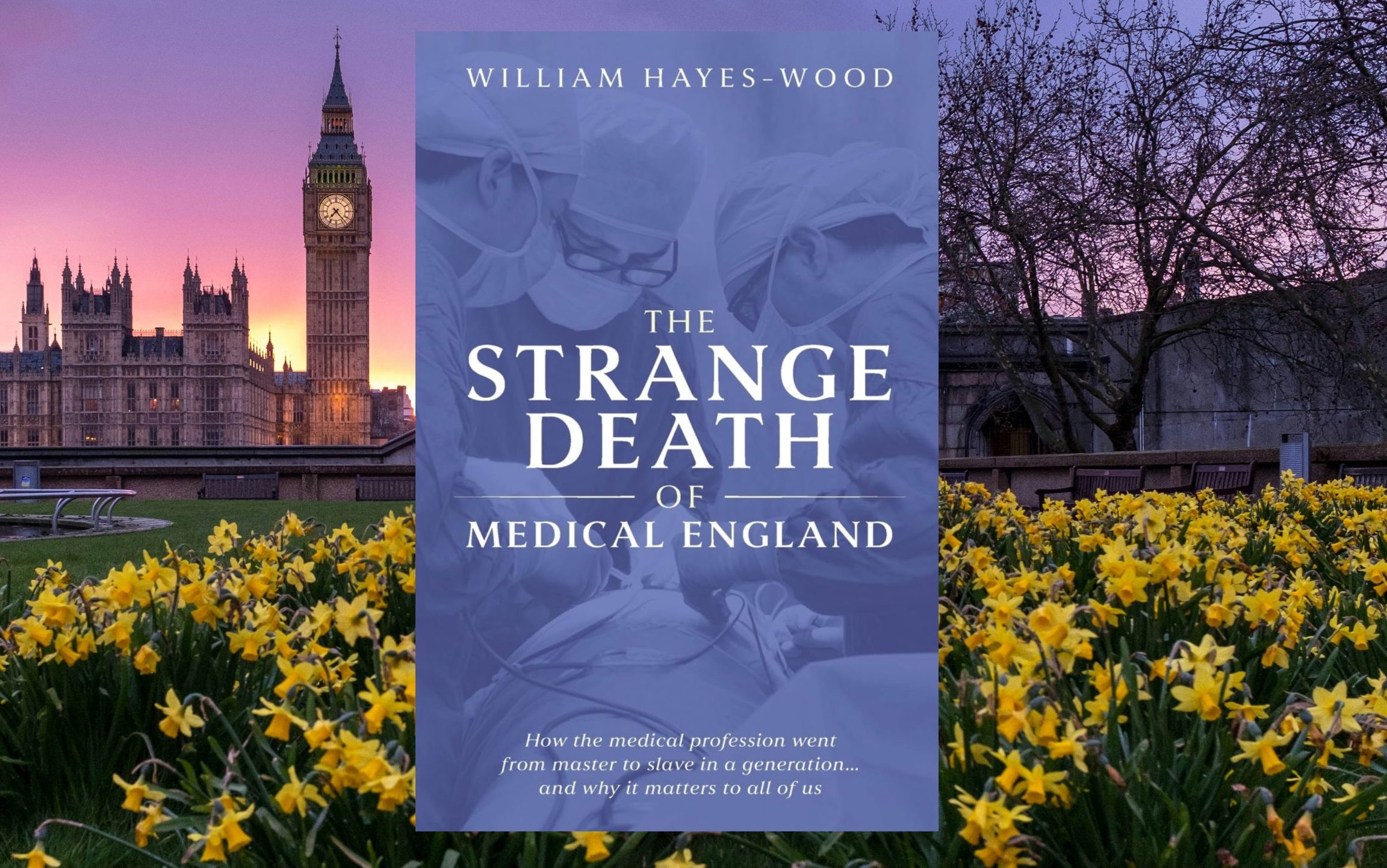
Hayes-Wood is a recently retired veteran NHS consultant surgeon. He is clearly disillusioned with the trajectory of his pre-loved profession, yet remains idealistic enough to want to heal and reverse the major losses and damage he has witnessed. The subtitle of this pithy slim volume is ‘How the medical profession went from master to slave in a generation … and why it matters to all of us’. These two questions are answered with great clarity and easy conversationally-styled engagement – his narrative has a refreshing lack of academic or data references. History and current problems of great complexity are rendered very comprehensible for the non-specialist reader.
Early on, a central notion:
‘… healthcare in the UK is in danger because of a change in political philosophy at the very top of government which began 40 years ago and which successive governments have chosen to build on ever since … in order to achieve these changes it was an essential prerequisite to neutralise the power and influence of the one body that could frustrate their plans – the medical profession.’
‘I have always thought, and this remains my view, that healthcare is better directed by doctors and other trained professionals working together, rather than by politicians or health insurers responsible to their shareholders.’
The subtitle of this pithy slim volume is ‘How the medical profession went from master to slave in a generation … and why it matters to all of us’.
His outlined history of how this happened covers eighty years and, in some places, contains details that will surprise many. For example, although the NHS was born and incubated within the first post-war Labour government, it was conceived earlier, in the midst of World War 2, by a coalition government. In particular, William Beveridge, Liberal politician and economist, and Conservative Health Minister Henry Willink were major contributors to the White Paper A National Health Service, published in 1944 – the year before Clement Atlee’s Labour Party won power. Clearly there was, then, a political consensus of support across the political divide, for a universally accessible health service ‘from the cradle to the grave’.
Such consensus did not initially extend so readily to the doctors, many of whom fought a suspicious and defensive battle against any government hegemony. Yet with canny toughness and clever diplomacy Labour’s Aneurin Bevan managed to disperse this opposition and won the doctors’ acquiescence or even tentative support. Remarkably, within a decade most doctors rapidly became vocationally committed to their NHS work. In these early decades the acceptance and appreciation of such an NHS led Chancellor Nigel Lawson to say in 1992 ‘the NHS is the closest thing the English people have to religion’.
But such relative stability unravelled from the 1970s into the 1980s. The long consequences of post-war debt and damage, the dispersal of the British Empire, the crumbling of prior industrial and manufacturing supremacy, led to accumulating financial, employment, labour and social problems and then disruptions.
Both Labour and Conservative governments foundered and floundered in attempts to govern. Enter a new leader who neither accepted or appreciated – Margaret Thatcher. She was convinced – and convinced many others – of a radical solution: Neoliberalism. Hence competitive marketisation and monetised commissioning would be legally mandated wherever possible; waste would be cut; motivation, discipline and efficiency would be enhanced; and the State’s burdens and responsibilities much reduced.
Thatcher included the NHS in this mission and employed Roy Griffiths, a Sainsbury’s Supermarket director, to report.
Coming from such a background it was clear that Thatcher expected Griffiths to look at the NHS as a private sector company rather than as a state-funded organisation providing essential services based on the citizen’s requirements. Of course, the overriding duty of a private sector business such as a chemical company or supermarket is to provide monetary profit for its shareholders, a concept which is meaningless to a nationalised provider of healthcare. Moreover, if the company fails to make money it can be wound up, dissolved or cease to exist. Another concept inapplicable to the NHS.
Another paradox was this:
Griffiths stated that when it came to management and accountability in the NHS as he found it in 1983, basically there was none.
The paradox here is that the NHS in 1983 was, for all its unevenness and inadequacies, comparatively, according to many international studies, offering the UK population the safest and most cost-efficient health service worldwide. For this to be true there must have been some very effective kind of management and accountability, but it was of a colleagueial and vocational kind – not recognisable to the likes of Griffiths and Thatcher, who understood corporate manufacture rather than human welfare.
This paradox – or rather discrepancy – has continued, very problematically, until the present time. Much of what Hayes-Wood writes so painfully about derives from this. However much patients, practitioners or academics demonstrated the inefficiency or dislike of increasingly corporate neoliberalised micromanagement, the Griffiths-Thatcher approach has continued, despite successive governments promising to reform the reforms.
Thus, by the time Labour left government in 2010, there was more private sector involvement in the NHS than there had been in 1997 when it came to power.
Hayes-Wood points out a kind of reverse parallel process:
It is ironic that the medical profession – somewhat wary of the NHS when it had been first set up by the Atlee government in 1948 – had morphed into some of the strongest supporters of state-run medicine and fiercest opponents of market-based economics being introduced into the NHS.
Herein lay the ruin Hayes-Wood so laments, because:
Despite their initial scepticism, the doctors had soon become amongst the staunchest defenders of the nascent NHS. They did not realise that they were opening the door to their own profession’s demise should an ideologically-driven government come to power which despised the post-war consensus.
And so, thirty years later, such a government did emerge and then:
… the doctors were ill-prepared to resist and, indeed, for a long time did not fully appreciate what was happening.
Hence the medical profession’s apparent inertia and discombobulation: the Thatcher-era reforms were responded to, largely, by a kind of post-concussional state. Many practitioners were uncomprehending of the suddenly strange and pugnacious new regime and retreated, if they could, into the work they knew and understood. A few, seeing clearly the changing power-tide, expediently became the government’s agents and collaborators. Even fewer at the time were those both perspicacious and courageous enough to articulate effective opposition.
All this was like a very effective coup d’état by an ideologically-driven minority group. The fact that its consequences have since been, predominantly, unpopular and ineffective have not hindered its durability – financial interests of wealthy ‘stakeholders’ are very formidable. And – as so often in life – it is far easier to get into things than to get out of them.
Here this veteran doctor surveys a widespread panorama of what we are now struggling with. The displacement of medical responsibility and initiative by commercial and corporate protocols and diktats; the compliance of the General Medical Council and Medical Royal Colleges to government policies, thereby becoming de facto government agents or commissars (in spite of the majority opposition of their professional members); the discouragement of personal continuity of care in favour of depersonalised large-team working (hence the demise of the Family Doctor and the hospital consultant-led team); the default ‘progress’ of merging smaller accessible services into much larger, centrally-managed units; the quasi-militaristic corralling and directing the working options for younger doctors, impeding their choice and autonomous development…
This book is a thoughtful threnody to a passing culture and imperilled values.
Some of these receive particular attention in The Strange Death. For example the agreement of both the GMC and the Royal College of Physicians to both train and register Physician Associates (non-doctors) despite significant opposition from their established professional membership. There is a harsh irony here because in 1518 the prototypal College of Physicians was started autonomously by pioneering university-graduated doctors to differentiate themselves from lesser-trained apothecaries and ‘quacks’. Three hundred and forty years later, in 1858, parliament’s Medical Act required the separate examination and registration of doctors to clarify the professional distinction from all other healthcare workers. The current government’s initiative jettisons such safeguards to professional boundaries and public safety.
The cumulative effect of all this has been erosive and egregious. With medical staffing: instability and unhappiness through declining work satisfaction and trusting familiarity and collegiality – thence to sickness, drop out, poor recruitment, early retirement. Then, of course, patients: the thinning out of services that become inaccessible, peremptory, often rushed and error-prone, and the near-extinction of personal continuity of care. Our NHS becomes, inexorably, more unhappy, unsafe, and much more expensive. The last of these is, surely, a tragic paradox and indictment of the reforms Hayes-Wood so ruefully describes.
This book is a thoughtful threnody to a passing culture and imperilled values. At its end he writes:
… it really is up to you – as an ordinary citizen and voter – to speak out and try to do something about it. The politicians, despite many fine words and false smiles, will not help you. The medical profession cannot … a National Health Service which can give identical treatment to individuals so far apart in the social strata, entirely non-judgementally, is something very special indeed. … Do not let them take it away from you. They will try.
Hopefully he can galvanise useful recruitment more than evoking impotent grief.
Featured book: William Hayes-Wood (2025) The Strange Death of Medical England, ukbookpublishing.com, ISBN 978-1917329934, £7.99
Featured Photo by Ming Jun Tan on Unsplash



Just got the book and read it on a train journey. It describes so well the de-professionalisation of doctors over the course of my working lifetime and, as the subtitle says, why it matters to everyone, not just us.