
 Terry Kemple is a retired GP, Bristol; has various roles promoting greater sustainability in general practice, including as Director for the Royal College of General Practitioners (RCGP) Green Impact for Health Toolkit; and is past President of the RCGP.
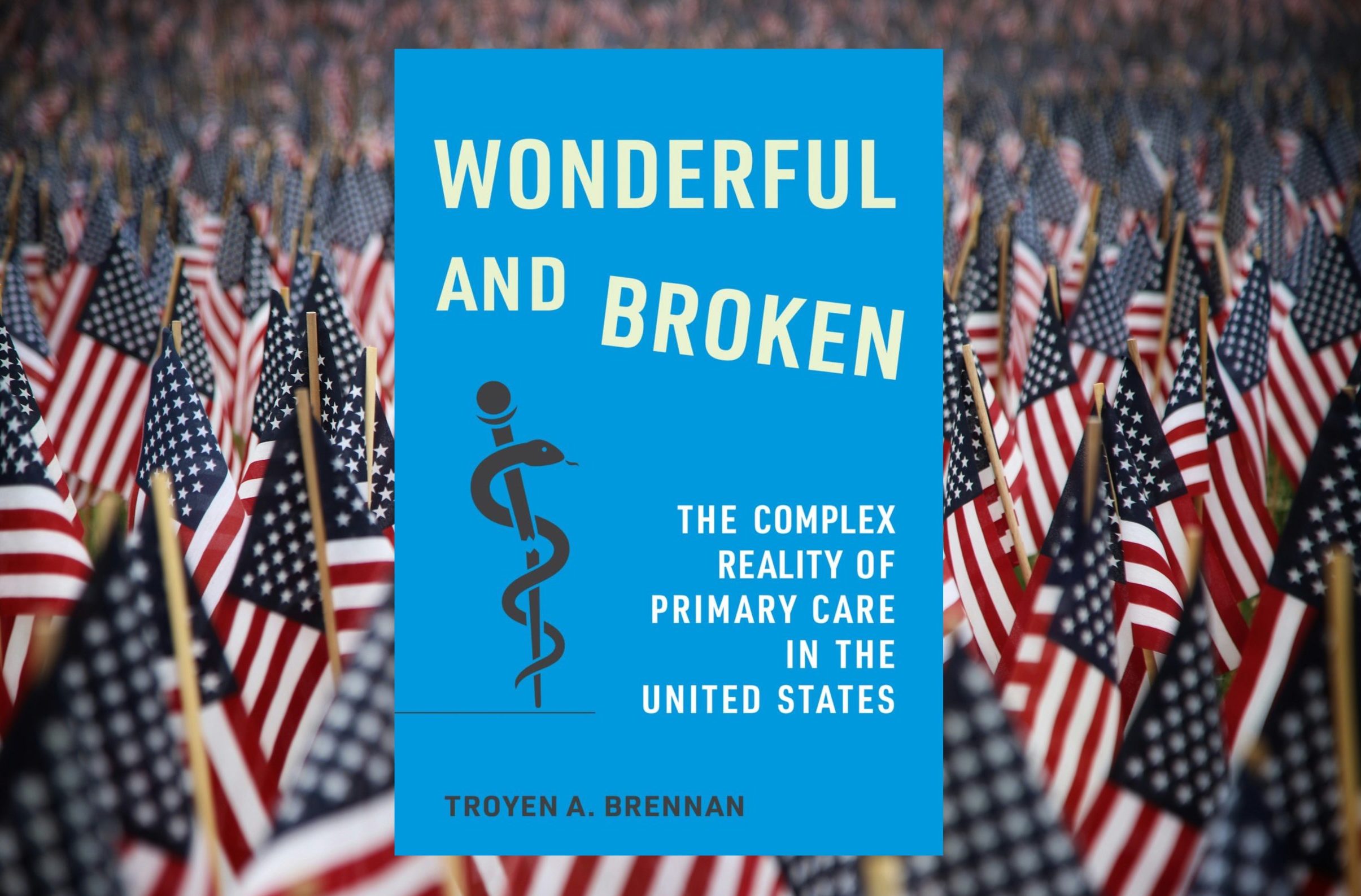
General practitioners (GPs) know the problems of too much work and too little support in the UK’s National Health Service. Troyen Brennan explores the complexities of the United States’ (US’s) primary care with its multiple systems of funding and its absence of universal health care cover and finds that primary care is wonderful but broken. He examines why this is and what can be done to fix it.
This is a carefully researched book by a health policy and management sage who conducted extensive interviews over two years within the different systems of primary care across the US. He finds that the essence of primary care in the US with its skilful use of medical expertise, its commitment to patients and the doctor-patient interactions at its centre can still be wonderful. Despite this it needs major changes and more funding to save it. Primary care has been weakened by its low reimbursement rates but now struggles to survive with the high patient demand for services. In the US relative expenditure in primary care is falling and is at around 3-5% of all health care spending. In England the core funding for general practice accounts for around 6 % of the NHS budget.
Brennan believes the only viable solution for costly US health care systems is vibrant primary care.
Brennan believes the only viable solution for costly US health care systems is vibrant primary care. Most people still value a longitudinal relationship with someone who knows them. He says any rational individual who considers the data on the efficacy of primary care would judge that health care authorities must not allow primary care to deteriorate further – all the alternatives are unaffordable. Health funders need to work more upstream with primary care to limit the over investigation and over treatments in US healthcare. Brennan searches for and finds examples of funded and successful value-based healthcare that contrast with the traditional fee for service funding. Value-based primary health care is an approach to organizing and paying for primary care that focuses on health outcomes and patient experience relative to cost, rather than on the volume of services delivered. Providers are rewarded for keeping people healthy, not for seeing them more often or doing more procedures. The belief is that costs can be reduced if a primary care doctor chooses diagnostic and therapeutic interventions wisely whilst at the same time giving excellent care and anticipating what patients need.
Although primary care in the US is different, many of the problems are the same as in the UK. The core primary care specialties in the US include Family Medicine but also General Internal Medicine, Paediatrics, and Obstetrics and Gynaecology. They are all struggling to survive. Their problems include being overworked, undervalued and under resourced compared to other medical specialities in secondary care. They battle problems to provide primary care, particularly in recruiting and making a life in primary care practice liveable.
How have our different primary care systems ended up with a similar existential crisis?
How have our different primary care systems ended up with a similar existential crisis? Exploring other countries’ systems of healthcare can help us to understand the problems of our own better and find practical solutions. We share the quadruple aim of health care to enhance patient experience, improve population health, reduce costs and improve the work life of health care providers. We share difficulties that include being undervalued within the health care world, working long hours, being under resourced, coping with bureaucracy, increasing inbox exhaustion, getting deskilled, poor recruitment and retention and getting burnt out. A difference is that in the US primary care doctors need to escape the fee for service payments that incentivise them to see as many patients as possible each day. These still underpay them and overpay secondary care doctors and result in over investigation and over treatments.
Brennan’s vision of the practice of the future is one funded by prospective payment so that the fundamental financial incentive is aligned with the fundamental therapeutic incentive: keeping the patient healthy. The primary care clinician will have fewer patients, keep a close watch on their medical problems, and work with a team of other clinicians who can help. The relationship with patients will thus be durable and meaningful, which along with appropriate work/life balance sustains the clinicians. Changing it will make it more cost effective and produce higher quality care. The practice of primary care will become much more conducive to the kind of whole person care that patients need and that clinicians want to deliver.
He acknowledges some of the prejudices against primary care as a speciality but does not address why the work and workers in primary care remain undervalued. One rarely understood benefit is that the separation1 of primary care and secondary care within a healthcare system can provide higher-quality healthcare at a lower cost.2 Knowing all the benefits and countering all the prejudices will be essential if primary care is to become both wonderful and workable.
Featured book: Troyen A. Brennan. Wonderful and broken : the complex reality of primary care in the United States, Baltimore : Johns Hopkins University Press, 2025. ISBN 9781421452197, Hardback, 488 pages, £33.00
References:
- Mathers N, Hodgkin P. The Gatekeeper and the Wizard: a fairy tale. BMJ. 1989 Jan 21;298(6667):172-4. doi: 10.1136/bmj.298.6667.172. PMID: 2493843; PMCID: PMC1835499.
- Starfield B, Shi L, Macinko J. Contribution of primary care to health systems and health. Milbank Q. 2005;83(3):457-502. doi: 10.1111/j.1468-0009.2005.00409.x. PMID: 16202000; PMCID: PMC2690145.
Featured Photo by Bernd 📷 Dittrich on Unsplash