
 Kavinda Liyanage is a GP registrar in South West Devon, with a growing interest in behavioural science and its place in general practice.
Understanding the grandmother
Grandmothers are a fascinating part of our story as humans. We evolved to have unusually large brains, but giving birth to a large brained baby is constrained by both the size of the birth canal and the enormous metabolic demands of pregnancy. As a result, human babies are born relatively immature, with a brain approximately 30% of its adult size, leaving them dependent on others for many years, which is very uncommon in the animal kingdom.
“How did women in many ancestral and pre-industrial societies manage to have several children … when many parents today struggle with the demands of raising just one?”
This raises an interesting question. How did women in many ancestral and pre-industrial societies manage to have several children, often while their previous children were still dependent, when many parents today struggle with the demands of raising just one?
Nature appears to have found a clever solution: the grandmother! At least, that is the idea proposed by the grandmother hypothesis.1–3
Humans are among the few species in which females live for many years beyond their reproductive age. The grandmother hypothesis proposes that this long post-reproductive lifespan offered an evolutionary advantage. Rather than having more children themselves, older women could continue passing on their genes indirectly by helping in raising the next generation.
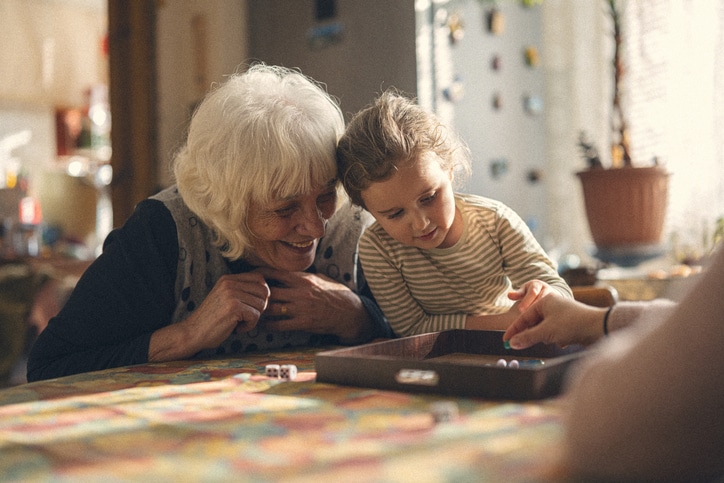
Grandmothers could help protect, feed, care for and entertain their grandchildren, reducing some of the burden on the mother. This may have allowed mothers more time to rest, recover and shortened the time before another birth. So, in a roundabout evolutionary way, we may owe our big brains to our grandmothers.
“Nature appears to have found a clever solution: the grandmother!”
What do grandmothers get?
The benefits of this relationship may flow in both directions. A recent study using data from the English Longitudinal Study of Ageing found that grandparents involved in caring for their grandchildren performed better on tests of memory and verbal fluency and experienced a slower decline in cognitive function.4 The association appeared particularly noticeable among grandmothers.
“… grandparents involved in caring for their grandchildren performed better on tests of memory and verbal fluency and experienced a slower decline in cognitive function.”
Additionally, spending time with grandchildren may also encourage physical activity, reduce loneliness and provide cognitive stimulation, and provided a sense of purpose. Therefore, a grandmother’s contribution to her family may support her own wellbeing as well as that of the younger generations.
Importantly, more care is not necessarily better; occasional and voluntary involvement appears more likely to be beneficial, while extensive or a forced role of caregiving can lead to stress, fatigue and poorer health.
Grandmothers in general practice
The role of grandparents may be underestimated not only within society but also within medicine. Although perinatal care increasingly recognises the importance of social support, research has concentrated mainly on partners or on social support as a broad concept. The particular contribution of grandparents remains comparatively understudied.
“… we should recognise and support grandmotherhood as a potentially health promoting role that may benefit everyone involved.”
The limited evidence available suggests that supportive grandparental involvement is associated with better maternal mental health.5 The association appears to be stronger for support from the mother’s own mother. Supportive grandparental involvement has also been associated with modestly better mental health and developmental outcomes in children.
Perhaps, as GPs, this is an area we should pay greater attention to. We spend considerable time helping expectant parents plan where and how their baby will be born but spend less time asking who will support them once they take that baby home and whether the mother has a reliable community around her.
I have deliberately used the phrase ‘supportive grandmother’. The word supportive matters. A grandmother’s presence alone is not necessarily protective. Unwanted advice, criticism, interference or conflict over feeding and childcare may add to a new mother’s distress rather than relieve it. Support must therefore be invited, respectful, and shaped around what the mother actually needs.
The grandmother hypothesis should not become an expectation that older women provide free childcare. Instead, we should recognise and support grandmotherhood as a potentially health promoting role that may benefit everyone involved. It reminds us of something modern healthcare can easily overlook: raising a child has never truly been an individual task.
References
1. Hawkes K, O’Connell JF, Jones NG, et al. Grandmothering, menopause, and the evolution of human life histories. Proc Natl Acad Sci USA 1998; DOI: 10.1073/pnas.95.3.1336.
2. O’Connell JF, Hawkes K, Blurton Jones NG. Grandmothering and the evolution of homo erectus. J Hum Evol 1999; DOI: 10.1006/jhev.1998.0285.
3. Alvarez HP. Grandmother hypothesis and primate life histories. Am J Phys Anthropol 2000; 113(3): 435–450.
4. Chereches FS, Olaru G, Ballhausen N, Brehmer Y. Grandparents’ cognition and caregiving for grandchildren: Frequency, type, and variety of activities. Psychology & Aging 2026; DOI: 10.1037/pag0000958.
5. Riem MME, Bakermans-Kranenburg MJ, Cima M. Grandparental Support and Maternal Postpartum Mental Health. A Review and Meta-Analysis. Hum Nat 2023; DOI: 10.1007/s12110-023-09440-8.