


 Simon Absil is a general practitioner and researcher at the University of Namur, Belgium. His interests include the history of medicine and medical humanities, as well as clinical decision-making.
Over the last three decades, evidence-based medicine (EBM) has become a central paradigm in modern Western medicine. By integrating the best available evidence with clinical expertise and patient values, it provides a widely accepted framework for clinical decision-making.
Yet, while EBM identifies the key elements that should inform decisions, it says relatively little about how these elements are brought together in everyday consultations. How is scientific evidence interpreted through clinical experience? How are patient values incorporated into recommendations? And how are these judgements communicated in situations of uncertainty?
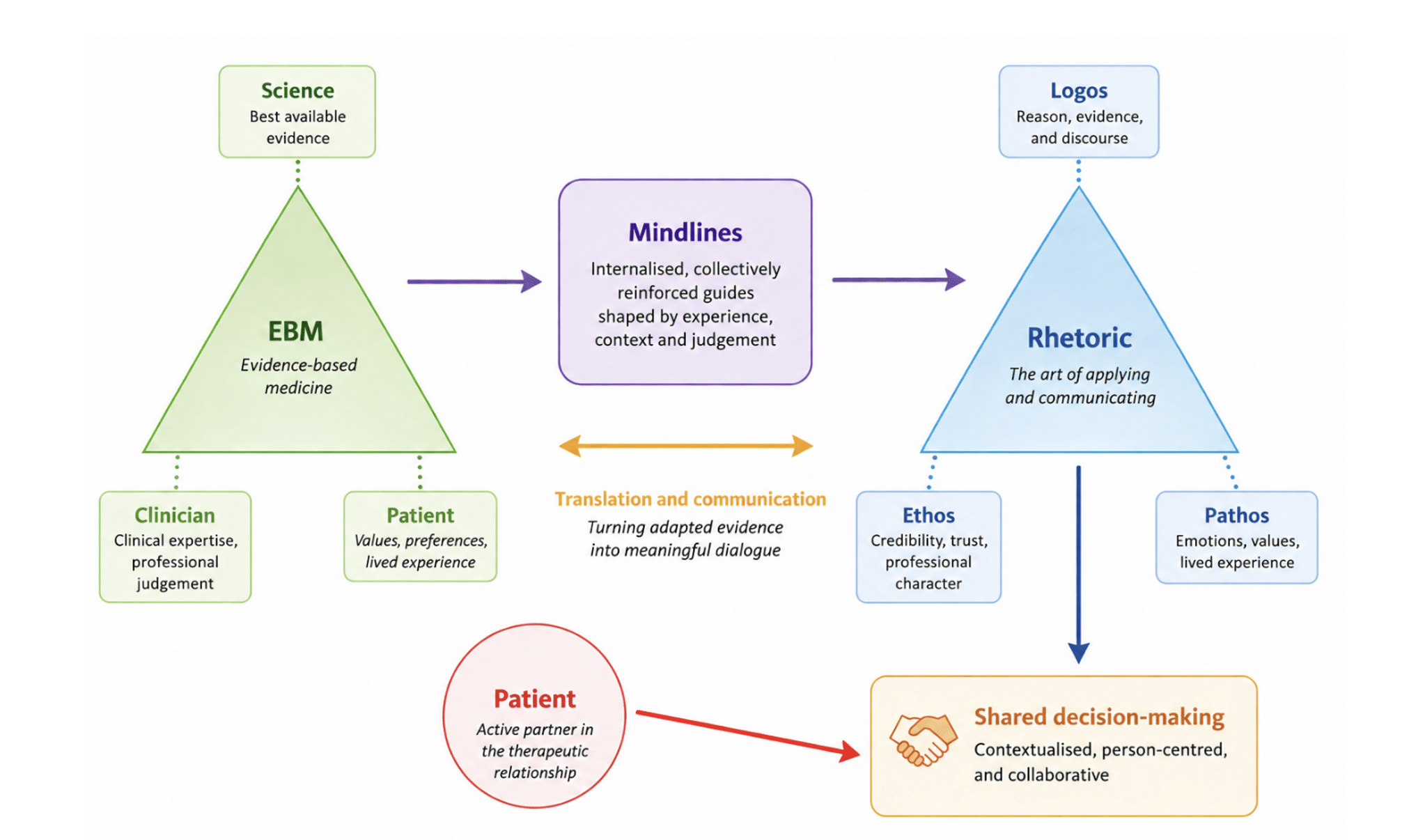
I would like to propose that Aristotle’s theory of rhetoric may offer a useful framework for understanding how evidence, expertise, and patient values are brought together in clinical practice. Drawing on the classical concepts of logos, ethos, and pathos, striking parallels emerge with the three pillars of evidence-based medicine. More importantly, this rhetorical framework may help explain how evidence, expertise, and patient values are interpreted, integrated and translated into shared decision-making.
Aristotle’s theory of rhetoric may offer a useful framework for understanding how evidence, expertise, and patient values are brought together in clinical practice.
The concept of evidence-based medicine emerged in the early 1990s through the work of David Sackett and Gordon Guyatt who introduced a new teaching approach initially called “Scientific Medicine”. The aim was to promote critical thinking in clinical decision-making through the use of research evidence. As this term would lead to misleading connotations –such as carrying the idea that the rest of clinical medicine is not scientific– the term “Evidence-Based Medicine” was subsequently adopted.1
However, evidence-based medicine is not simply the application of research evidence to individual patients. Rather, it involves the integration of the best available evidence with patient values and clinical expertise. This triad is fundamental, yet it is frequently reduced to a narrow interpretation centred on scientific rigour alone.2,3
Evidence-based medicine has also been described as a rhetorical practice, in which persuasion and context influence how evidence is interpreted and applied.4 Yet, this rhetorical dimension remains largely implicit and has rarely been explicitly conceptualised.
In this essay, I propose to make this rhetorical dimension explicit by interpreting the EBM triad through the Aristotelian framework of logos, ethos, and pathos. To do so, we can examine how these classical rhetorical concepts may correspond to the three pillars of evidence-based medicine.
In classical rhetoric, three modes of persuasion were described by Aristotle in Rhetoric (Book I, Chapter 2):5
- Logos (λόγος): reason, logic, and discourse itself; the use of evidence and rational argument—and the way it is framed—to persuade.
- Ethos (ἦθος): character and credibility; the speaker’s authority and legitimacy. Ethos is also related to ethikos (ἠθικός), referring to moral character and conduct.
- Pathos (πάθος): emotion; appealing to the audience’s feelings to influence.
Now that these two triads have been outlined, we can explore how they may be connected.
First, logos can be understood as the foundational element of the triad—the logical and evidential core of argumentation. In evidence-based medicine, this directly corresponds to scientific evidence, which forms the basis on which clinical decisions are built. However, logos is not limited to evidence alone. It also encompasses discourse itself, the way information is expressed and framed. Thus, this reminds us, beyond presenting scientific data, clinicians must articulate it in a clear and meaningful way, ensuring that it resonates with and is understood by the patient.
Second, pathos can be related to patient values. Literally, pathos refers to suffering and emotion. In medicine, this resonates with the patient’s lived experience. The term patient derives from the Latin patiens (“one who suffers”), itself related to the Greek pathos. In clinical practice, pathos is not about appealing to emotions to persuade, but rather about recognising and integrating patients’ emotions, perceptions, and experiences into clinical decision-making.
Third, ethos in the medical context refers to the clinician’s credibility and legitimacy to speak. It is what enables clinicians to go beyond scientific evidence and apply it in a way that aligns with the patient’s agenda. Clinical expertise encompasses not only knowledge of the medical condition, but also an understanding of the patient as a person. The relationship developed with the patient fosters trust, which in turn underpins the clinician’s authority and the patient’s acceptance of medical recommendations.
Furthermore, this perspective may also find practical expression in the concept of mindlines: the internalised, collectively reinforced guides that clinicians develop through experience, interactions with colleagues, and the personal integration of evidence into their own clinical practice. While evidence-based medicine provides a theoretical framework for clinical decision-making, mindlines represent its implementation in everyday practice. Although informed by shared evidence and professional norms, mindlines are shaped by each clinician’s experience, judgement, and accumulated clinical encounters. (6) In this sense, EBM may be understood as describing what should inform decisions, whereas mindlines reflect how those decisions are actually made within the realities of each consultation. After all, no consultation is entirely reproducible; each encounter brings together a unique patient, a unique context, and a unique moment in time.
An Aristotelian perspective may help explain how this process is communicated to patients. While mindlines shape the clinician’s judgement, logos, ethos, and pathos provide a framework through which evidence, expertise, and patient values can be brought together in shared decision-making. The clinician must explain not only what the evidence suggests, but why a particular recommendation is appropriate for a particular patient in a particular context.
If mindlines describe how clinicians adapt evidence to the realities of practice, rhetoric may help explain how this adapted understanding is communicated to patients.
In this sense, rhetoric offers practical framework for everyday consultations. If mindlines describe how clinicians adapt evidence to the realities of practice, rhetoric may help explain how this adapted understanding is communicated to patients. By translating evidence, expertise, and patient values into meaningful dialogue, it enables clinicians and patients to make decisions together. Viewed in this way, rhetoric may represent the missing link between evidence-based medicine and shared decision-making.
Ultimately, this interpretation requires a careful understanding of rhetoric. In medicine, rhetoric should not be understood as the art of persuading or convincing patients to accept a clinician’s view. Rather, it is a means of communicating evidence, professional judgement, and patient values within the consultation so that decisions can be made together. Viewed through this lens, Aristotle’s concepts of logos, ethos, and pathos offer more than a historical curiosity: they provide a useful framework for understanding how evidence-based medicine is translated into everyday clinical practice.
References
- Sur RL, Dahm P. History of evidence-based medicine. Indian J Urol. 2011 Oct;27(4):487-9. doi: 10.4103/0970-1591.91438.
- Evidence-Based Medicine Working Group. Evidence-based medicine. A new approach to teaching the practice of medicine. JAMA. 1992 Nov 4;268(17):2420-5. DOI: 10.1001/jama.1992.03490170092032
- Sackett DL, Rosenberg WM, Gray JA, Haynes RB, Richardson WS. Evidence based medicine: what it is and what it isn’t. 1996 Jan 13;312(7023):71-2.DOI: 10.1136/bmj.312.7023.71
- Van de Ven AH, Schomaker MS. Commentary: The rhetoric of evidence-based medicine. Health Care Manage Rev. 2002 Summer;27(3):89-91. DOI: 10.1097/00004010-200207000-00009
- Rhetoric. Translated by W. Rhys Roberts. The Internet Classics Archive, Massachusetts Institute of Technology. Available at: https://classics.mit.edu/Aristotle/rhetoric.html
- Gabbay J, le May A. Mindlines: making sense of evidence in practice. Br J Gen Pract. 2016 Aug;66(649):402-3. DOI: 10.3399/bjgp16X686221