
David Misselbrook is a retired GP.
It would make for a memorable Monday morning surgery. Tales of loneliness in old age. The trauma of a major disaster. Love turned to hate by coercive control. A lifetime of bitterness from gay persecution. Depression. Rejection. And those are just the presenting symptoms, but we all know that lives are complicated.
“Salman Rushdie’s writing has something of a marmite factor, and I’m not even including those who have tried to murder him.”
Salman Rushdie’s writing has something of a marmite factor, and I’m not even including those who have tried to murder him. But this book, containing five recent short stories, is highly readable, straightforward, and contains just enough whimsical magic to keep us amused.
All the stories have a message. The final story, The Old Man in the Piazza, picks up one theme. It is an allegory of our abandonment of objective truth and indeed of the meaning-reference of language itself. Language is personified as a female protagonist who eventually abandons the populace leaving them, literally, speechless.
But I am writing this review because of the second story, The Musician of Kahani. Imagine if, by immense good fortune, you were born into a talented and wealthy family. And imagine if, as a young girl, you were recognised as a musical prodigy akin to Mozart. And you were beautiful. And the charismatic scion of a super-rich family falls in love with you. The wedding of the century.
But while your own family is worth a hundred million, your new husband’s family are multi-billionaires. And imagine that this family now decides that they have the right to control every aspect of your life. Of your social network. Of your pregnancy. Of the way you give birth.
“Perhaps Rushdie, of all people, has the right to interrupt his own story to talk about morality.”
Well, the rest of the story writes itself. Except, as it is Rushdie, there are a couple of rather extraordinary twists. But the most remarkable thing is that Rushdie abandons the fiction writer’s golden rule of ‘show, don’t tell’ and, prior to the denouement, launches into a mini polemic:
‘The present decay of ethical society around the world is a matter of some concern. Words such as “good” and “bad” or “right” and “wrong” are losing their effect, emptying of meaning, and failing, anymore, to shape society. Other words, such as “power,” “weakness,” et cetera, are replacing them. Also, “knowledge” is being replaced by “ignorance,” “memory” is being replaced by “forgetting,” and nothing, no shameful action, however atrocious, remains in the public mind for long. These are days in which “shamelessness” is king.’
Perhaps Rushdie, of all people, has the right to interrupt his own story to talk about morality. And has the skill to get away with it. It is still a remarkable intervention. Rushdie has a voice and he is not afraid to speak.
So, it’s not Midnight’s Children, more like bite-sized chunks of The Satanic Verses crossed with Haroun and the Sea of Stories (my favourite Rushdie). The stories explore right and wrong, the passage of time, even an un-ghostly ghost story that touches the heart. If you want a thoughtful read for a late holiday, or a good idea for a Christmas stocking, you might enjoy colluding with this light-touch Rushdie. Let’s hope that you don’t meet too many of the characters in your consulting room.
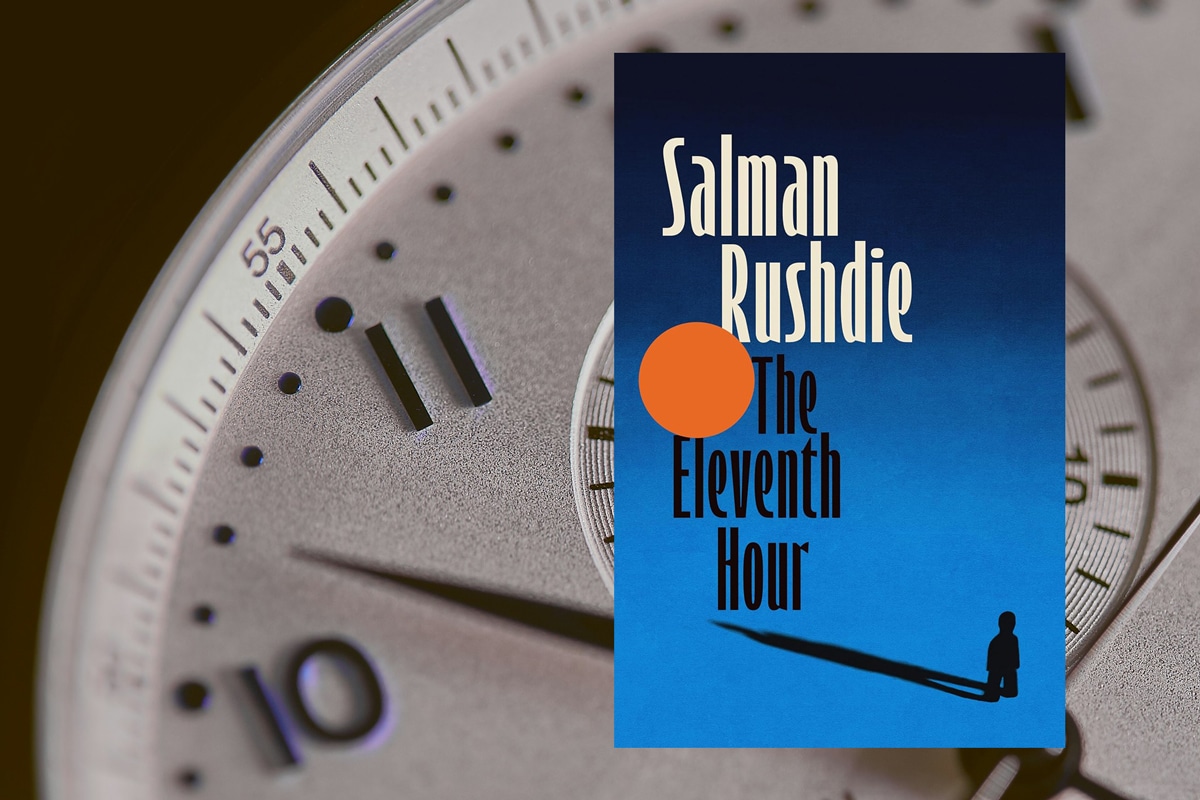
Featured book: Salman Rushdie, The Eleventh Hour, Vintage, 2026, PB, 272pp, £9.99, 978-1529968842
Featured photo by Agê Barros on Unsplash.