
 Andrew Papanikitas is Deputy Editor of the BJGP.
Mark Z Y Tan is an intensive care doctor and medical humanities scholar. This readily shows in a challenging and reflective memoir with lessons for both the wider medical profession and a public readership.
The back cover begs the question, “Airways, breathing, circulation, disability, exposure: perhaps the five most misunderstood words in life support.” Are they really? I am relieved to see the more cynical ABC of medial emergencies quoted early on, “Accuse, blame, criticise, delegate, exit.” It’s good to see grand claims tempered by self-deprecating humour (even if they are true!).
It’s good to see grand claims tempered by self-deprecating humour (even if they are true!).
Tan is keen to emphasise the idea that intensive care medicine stands out as one of the last bastions of generalist skills (p.1). I have some professional empathy there, even though he immediately describes intensivists as stepping in when the guidelines tell other specialties to seek expert help (less generalist?) or to mediate when experts disagree (more generalist?). This is something I’ve previously highlighted as an issue for medical ethics, asking whether specialism leads to narrowness of therapeutic aim.1 Tan beautifully illustrates the primacy of clinical acumen in the recollection of a patient who was been brought in with a suspected pulmonary embolus. He confirms the correct diagnosis with his newly gained ultrasonography skills – the new diagnosis has lifesaving implications. Expecting congratulation from his consultant, he is told, instead, that the diagnosis (heart failure) could have been made without the ultrasound. He is saved from an irate and impolitic reply by a tactfully distracting request for help by another colleague (p.115). This story is just one example of an excellent reflection, a shared lesson on many fronts.
It’s telling in a rather splendid way that the musical elements invited me to dust off the relevant CD and listen to it as I continued to read.
The experiences of intensive care that the book draws on are forged and tempered in the COVID-19 pandemic -indeed his reflections have contemporaneously featured on BBC Radio 4 (These are included as appendices). I am very relieved to see a statement at the beginning of the book on confidentiality in respect to patients and their families as well as to colleagues. The patients are anonymised and disguised with similarities to existing people being coincidental -do you remember reading this kind of statement on movie credits, before the huge teams involved in the computer graphics meant they became too long to read? I take this to mean that they are fictionalised. The authors’ experiences are given a new fictional cast of characters so the author’s story can be shared without a breach of trust. This remains my fundamental concern with medical memoirs and why I do not expect to write a memoir in a hurry.2 I’m not sure how this fictionalisation extends to the author’s reflections on his own family, particularly his grandmother, but I am presuming that these reflections take place with consent or assent.
If this book has any weaknesses it is because its author is bursting with ideas, has a connection to arts and humanities that is broad and deep, and is aiming for the wider audience. I wonder if it tries to do too much. For example, there is a passage (p.3) which references popular books on colonial empires and mycology (yes, the study of fungi) in an attempt to make a point about appreciating opposites. References to music are threaded through the book and musical notation in is offered at times in lieu of inspirational quotation. As someone who tries to play the piano I attempted to play some of the notes but these felt frustratingly decorative. The music adds a ‘Je ne sais quoi,’ but needs more translation to land with the average reader. It took me a beat to recognise Bach’s Weihnachtsoratorium as Bach’s Christmas Oratorio. Despite my grumbles, it’s telling in a rather splendid way that the musical elements invited me to dust off the relevant CD and listen to it as I continued to read. However, the stories are the USP of this book. They are excellent; challenging, thoughtful, reflective and elegant. Moreover they are relatable beyond intensive care -transferable as the sociologist might say.
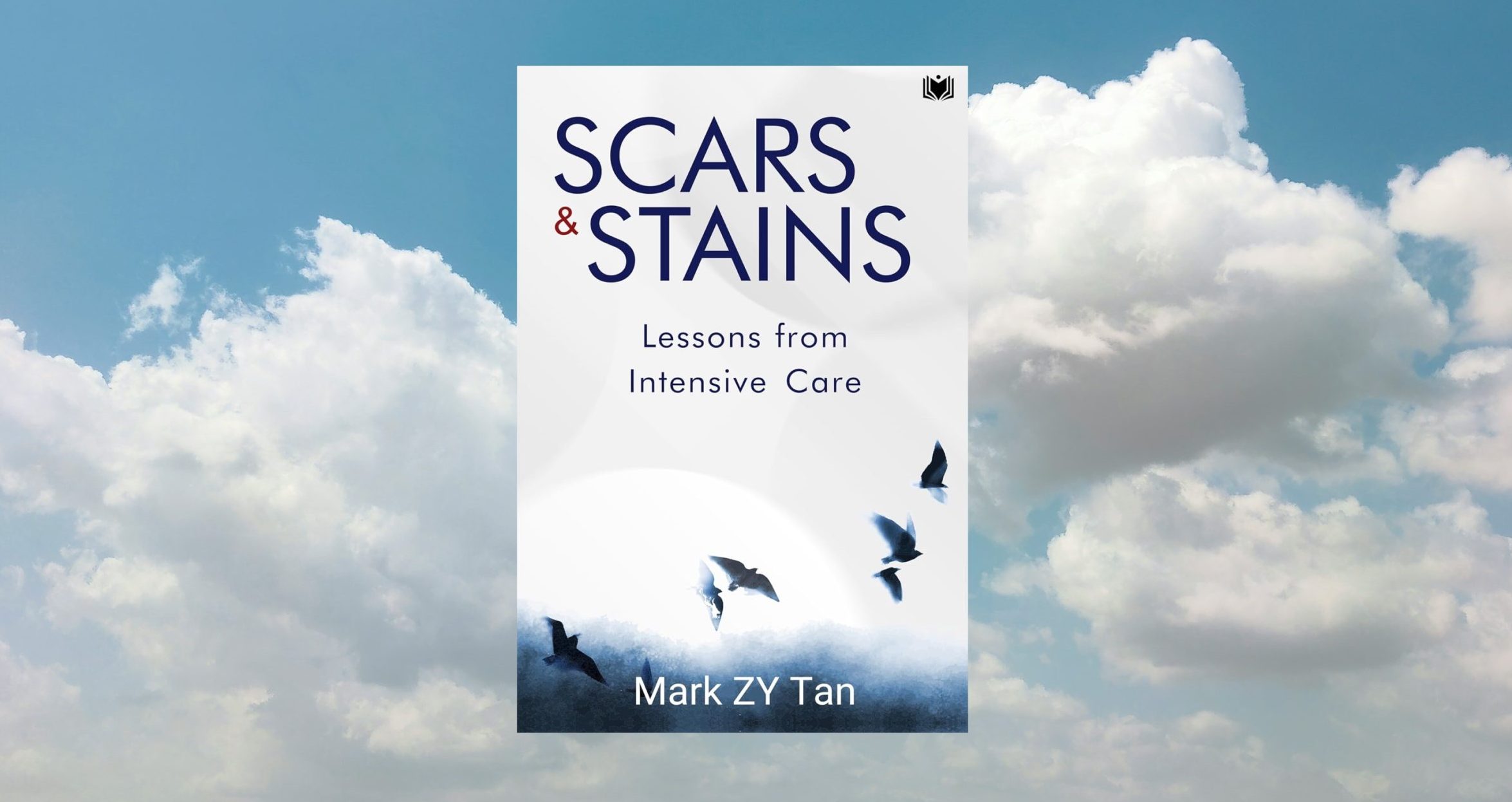
Featured book: Mark Z Y Tan, Scars and stains: Lessons from intensive care, Hawksmoor Publishing, Oakamoor 2024, ISBN 9781914066528
References
- Bahal N, Papanikitas A, Sokol DK. A bleeding controversy: duties and decisions in the face of conflicting advice. Int J Surg. 2010;8(1):32-4. doi: 10.1016/j.ijsu.2009.10.002. Epub 2009 Oct 12. DOI: 10.1016/j.ijsu.2009.10.002
- Papanikitas A, https://bjgplife.com/the-real-doc-martin/ [accessed 18/9/26]
Featured photo by Ankur Verma on Unsplash