
Ben Tyler is a first-five GP in Derbyshire with a special interest in obesity and exercise medicine.
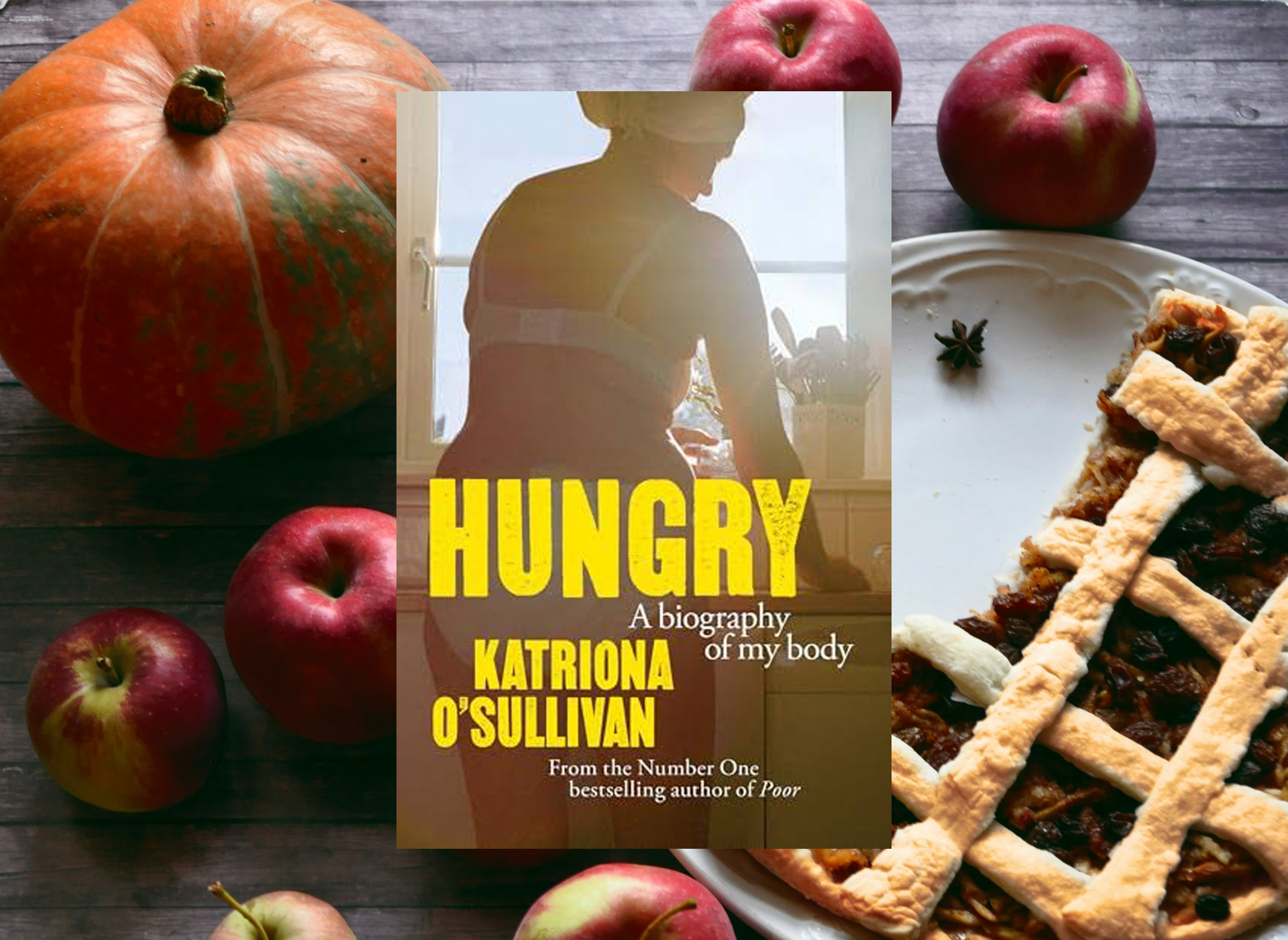
Katriona O’Sullivan came through a childhood of neglect, sexual abuse and poverty and now has a PhD, a professorship, and a number one bestseller. And still she believed she would be worth more if she weighed less.
Hungry is not really about weight, it is about what was done to O’Sullivan, what she did to survive, and the lasting consequences for her body and sense of self. She shows you cannot understand her relationship with food until you have understood everything that came before it. She describes herself as a hungry child, starved of both love and food at once.
‘…we are taught that our worth is tied up in how beautiful we are to men’.
Reading it, I kept thinking about what we currently offer people living with obesity, and the two common mistakes we see. Hers is the familiar one: if I lose another stone, I will be happy. She writes ‘we are taught that our worth is tied up in how beautiful we are to men’. Ours is the notion that if the patient would just make the changes we suggest, like moving more, eating differently, or living the life we imagine is available to them, then they would be happier. Both of these are arrival fallacies, with neither destination decided by the patient themselves.
Two themes recur through the book. The first is exhaustion: she is tired of the effort of constantly striving for more and the constant dieting. The second is being the ‘good girl’ — the child performing for a father’s approval, the woman performing for everybody else’s. Put those together in a consultation. When someone has spent decades earning approval by complying, consultation itself becomes another performance. She tells me what she thinks I want to hear and I reward that performance by adding another thing to do.
Some cast GLP-1 receptor agonists as a surrender of agency; you have outsourced your willpower to a pen. I think it is closer to the reverse, someone fighting a hormonal drive in a food environment engineered to defeat them was never free to begin with. Quietening that biology does not remove agency; it is often the first time there has been any left over to exercise. A recent qualitative study found precisely this with patients describing the medication as a facilitator rather than a replacement for change, one participant explaining that she could finally act on knowing she did not need to eat, because the craving was no longer there.¹
‘… someone fighting a hormonal drive in a food environment engineered to defeat them was never free to begin with.’
And on this O’Sullivan challenges me, in her closing pages she names the injections alongside the diets and the operations. For O’Sullivan, another intervention on her body was never going to address the thing she most needed. She captures this in her first meeting with Máire, her therapist: ‘I think I deserve to be happy. I want help with that.’
That is uncomfortable reading when considering the model of care we are busy building around these drugs. We call the wraparound care holistic, but look at what is actually in it: resistance training, protein, fibre (which matter enormously), but nothing about worth, or shame, or what the eating was doing for them. O’Sullivan’s memoir made me wonder how holistic care feels to someone who has spent 30 years being told what to do with her body.
Good general practice shifts the focus from the number on the scale to a goal the patient has set themselves. But that takes time which is hard to come by in the era of the e-consult. One of my patients wanted to walk down a set of stairs to the sea without stopping, something they had not managed in years. It mattered more to them than anything we measure. Most of our patients have not lived O’Sullivan’s life and we should be careful not to read her story onto them, and the point is not that everyone is carrying trauma but that everyone is carrying something. Sometimes the honest answer is that they are looking for something weight loss cannot give them. O’Sullivan describes going back to the clinic for a gastric band adjustment and noticing that the doctor ‘isn’t even looking at my face.’
‘Good general practice shifts the focus from the number on the scale to a goal the patient has set themselves.’
So, what have I learned? Be curious. Before asking ‘How can we help you lose weight?’, ask ‘What are you hoping losing weight will change?’ Stop saying ‘just’ and handing the failure back to the patient. Protect continuity, relationships can break down shame, whereas a stranger on a screen can let it grow. Build peer community to allow patients to recognise they are not uniquely broken. Which is of course exactly what this book does for the women reading it.
Reference
1. de Vere Hunt I, Ramirez-Posada M, Babu CS, et al. Patient experiences with GLP-1 receptor agonists. JAMA Netw Open 2026; 9(6): e2616951.
Featured Book: O’Sullivan K, Hungry: A Biography of My Body, Wildfire, 2026, 368 pages, hardback, ISBN 978-1035427772, £18.99
Featured Photo by Евгений Дмитриев on Unsplash