

 Trisha Greenhalgh is Professor of Primary Care Health Sciences at the University of Oxford, UK
Daniel Steenstra spent several years studying medicine, but he left before his final exams to spend eleven years designing cars, latterly at Jaguar. This book brings those two careers together. Its central claim, borrowed from Don Berwick, is that healthcare was “built wrong.” It was assembled piecemeal, he argues, never designed around the people it serves.
There is much here for GPs. The book explains the Design Council’s “Double Diamond” clearly: discover and define the problem, then develop and deliver the solution. The two diamonds are the same size because understanding a problem deserves as much effort as solving it. Healthcare habitually skips straight to solutions, as anyone who has lived through a digital-first initiative will recognise.
He argues that the NHS imported Lean’s tools (tidy stockrooms, standard work, visual boards) without Toyota’s underlying culture of learning and respect for people.
For me the strongest chapter is the one on Lean. The author has had a ringside seat, from Ford’s benchmarking of Toyota to the NHS “Productive” series, which many readers will remember. His central point is simple and important. Factories try to eliminate variation, but healthcare must be designed to respond to it. He argues that the NHS imported Lean’s tools (tidy stockrooms, standard work, visual boards) without Toyota’s underlying culture of learning and respect for people. That account rings painfully true.
The example I found most revealing is a description of designing the interior of the Jaguar XK8. Marketing handed the design team a brief that was already a list of features and cost targets. The designers went back to first principles and asked who the customers were and what would excite them. Once a sketch was chosen, he worked alongside ergonomists, engineers, suppliers, regulators, cost controllers and clay modellers, all at the same time. Real design, he admits, is not the tidy left-to-right journey the diagrams suggest; it means “going to and fro.” That honesty is refreshing. He then suggests this coordination mirrors what clinicians do when managing a complex ICU patient.
Here I part company with him. The XK8 was a hard project, but it was complicated rather than complex. It had fixed boundaries (a budget and a launch date), a board that signed off the design, and customers who paid. The clay model had no values, did not go on parental leave and did not refuse to cooperate. A well-known explainer about complexity thinking distinguishes building a rocket (complicated) from raising a child (complex). If the XK8 was a rocket, general practice is a child. Complicated problems yield to careful analysis. Complex ones need a probe-and-adapt approach, with no blueprint.
The book does include a section on complex adaptive systems, and it says many of the right things. But its language keeps slipping back into engineering. It promises to fix “root causes,” calls its logic chain “inescapable,” and concludes that healthcare “was built wrong. Now we can design it right.” A complex adaptive system is not built, and it cannot be designed right once and for all. It evolves. The people in the book’s systems are also rather thin. They are characterised mainly by their economic incentives. Human systems are complex partly because people hold values and professional standards, and these generate conflicts that incentives cannot explain.
My bigger reservation is the book’s origin story. The author argues that design thinking was built into healthcare “when physicians were still in control,” until managers took over. The chapter on Lean pushes this further. It suggests the NHS spent a fortune teaching improvement methods to clinicians who already had a superior methodology, but were excluded from leadership. This will flatter many readers of this journal, but I am not persuaded.
First, no evidence is offered for a golden age of clinician-led system design. Second, the same chapter observes that the Productive programmes preserved traditional hierarchies in which consultants held authority and nurses followed protocols. That hardly sounds like a management takeover. Third, reasoning through a patient’s chest pain is not the same skill as redesigning an organisation.
The clay model had no values, did not go on parental leave and did not refuse to cooperate.
Clinicians can also be deeply conservative. Their “resistance” to change is often rooted in values, and sometimes it is wise and sometimes not. And in UK general practice, GP partners are the managers in many senses. It would be an interesting exercise to ask how many of our appointment systems were designed around patients rather than around ourselves.
The author rightly says that those who led the NHS’s Lean programmes should not be scapegoated. I wish that generosity extended to managers throughout the book. The clinicians-as-heroes, managers-as-villains framing is unhelpful. It also sits awkwardly with the co-design ethos the book otherwise champions.
None of this is fatal. The book is energetic, readable and full of good ideas. For a second edition, I would ask the author to do two things: replace the clinician–manager polarisation with a more nuanced account of how the two work together; and take complexity beyond incentives to include the human values and conflicts that make healthcare so hard to design.
Rockets can be designed right; health systems, like children, can only be raised well.
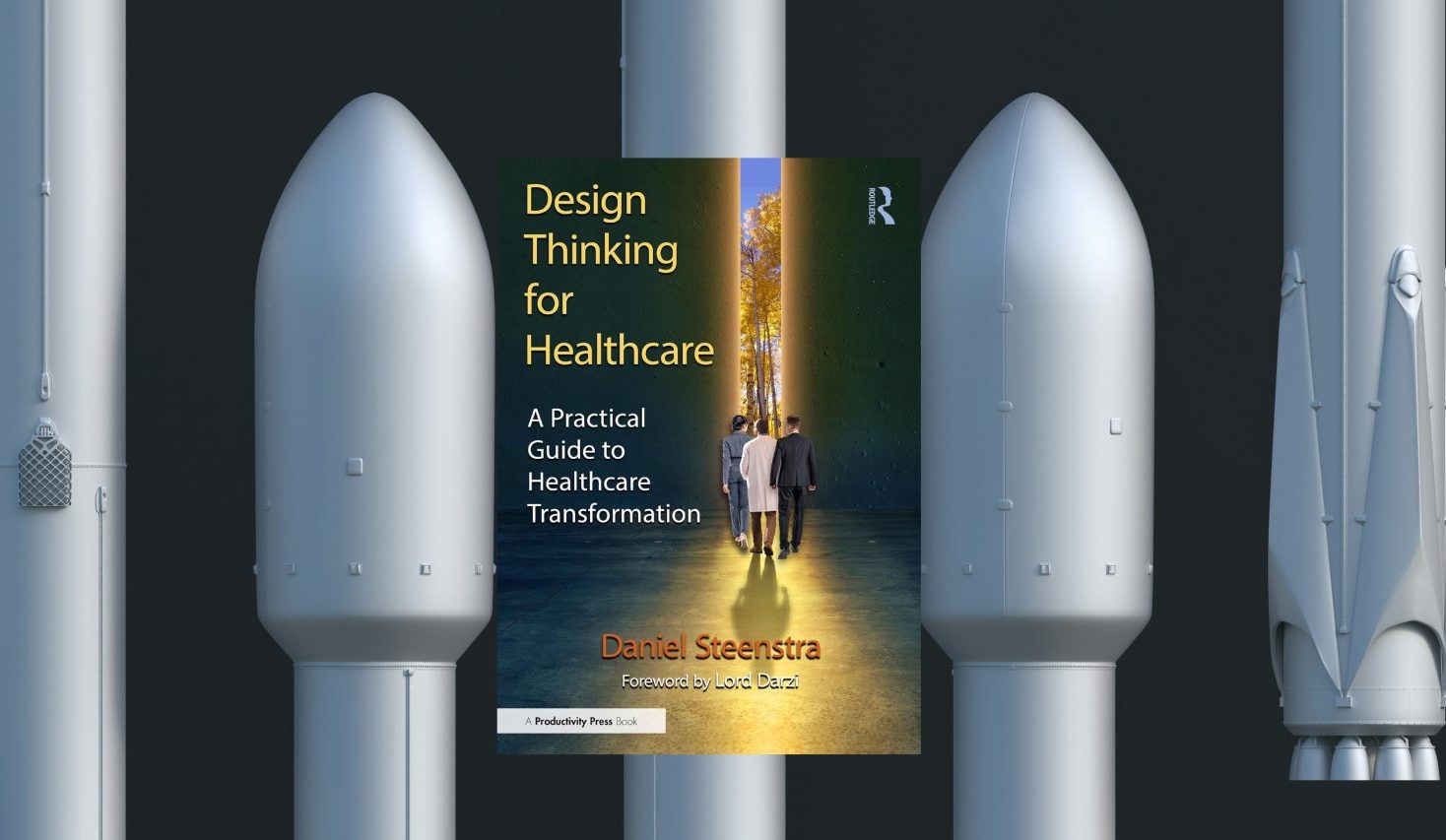
Featured Book: Design Thinking for Healthcare: A practical guide to healthcare transformation. Daniel Steenstra. Routledge, 2027. 327 pages, £46.99 (paperback edition). ISBN: 9781041269397 (hbk); ISBN: 9781041269335 (pbk); ISBN: 9781003752073 (ebk); DOI:10.4324/9781003752073