

 Terry Kemple is a retired GP in Bristol; has had various roles promoting greater sustainability in general practice, including as Director for the Royal College of General Practitioners (RCGP) Green Impact for Health Toolkit; and is past President of the RCGP.
Are we risking having more but becoming less? No one knows where the global race to develop the most powerful artificial intelligence (AI) will lead. What futures are possible? What direction should humanity choose? What goals should guide us?
We live in a time of rapid changes. While many people enthuse about the benefits of new technology, others are watching, waiting, and hoping for the best. The more difficult challenge is not the invention of new technologies, but guiding and governing them so that they serve the common good.
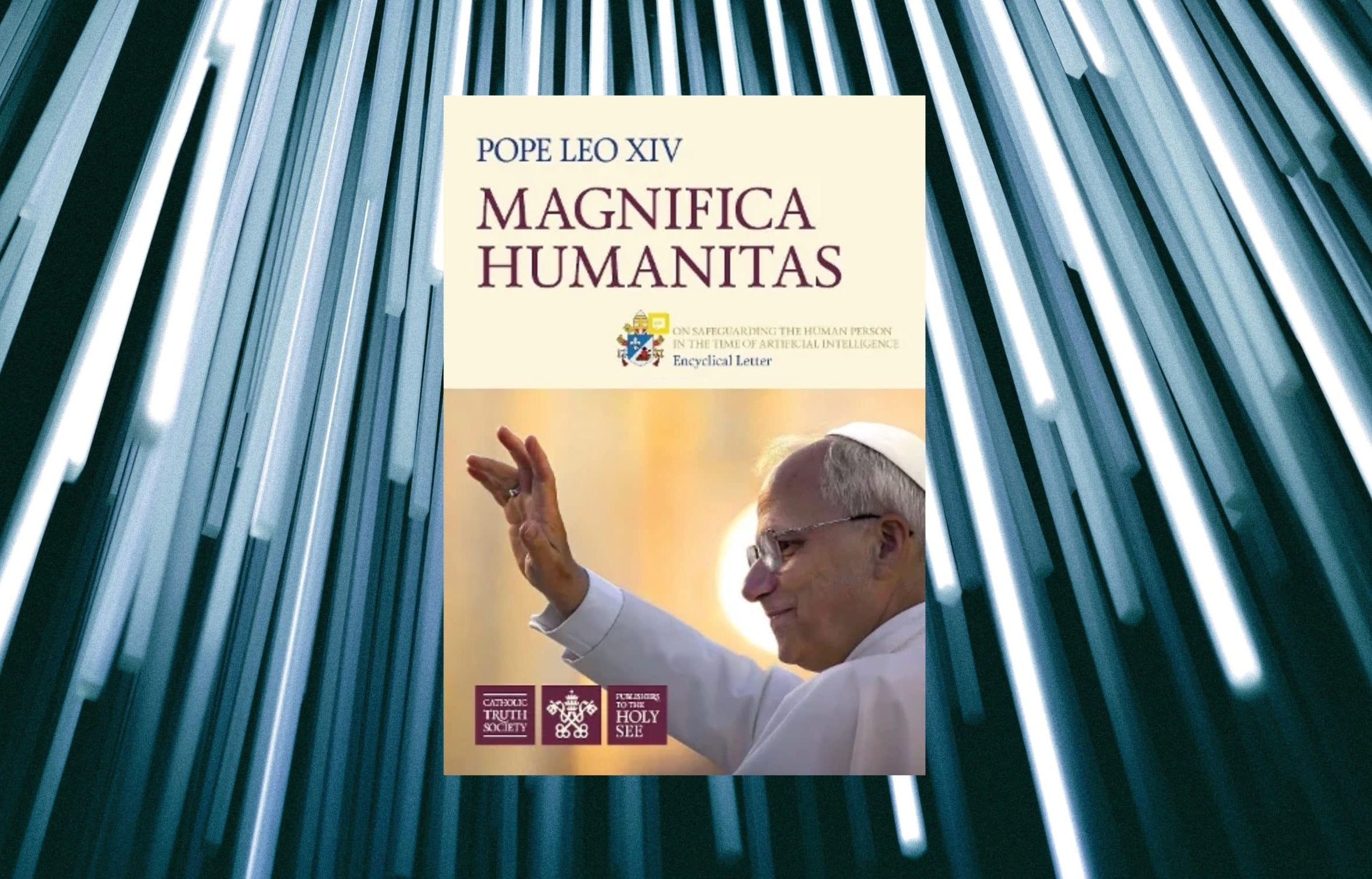
In his encyclical Magnifica Humanitas (The Greatness of Being Human), Pope Leo XIV offers moral guidance. The word encyclical comes from a Greek word roughly meaning ‘widely shared’. Traditionally, encyclicals were letters circulated among churches to provide moral teaching, spiritual guidance, and practical advice for living well.
Traditionally, encyclicals were letters circulated among churches to provide moral teaching, spiritual guidance, and practical advice for living well.
In 1891, Pope Leo XIII published Rerum Novarum (New Things), which addressed economic and political issues. It marked a major development in Catholic social teaching. Since then, successive Popes have applied Christian principles to the challenges of their own times. Together, these teachings form what is known as Catholic Social Doctrine.
Magnifica Humanitas is a long letter -144 pages. It begins by tracing the development of Catholic social teaching. It explains how each Pope contributed new insights for the challenges of their era. The Catholic Social Doctrine includes five key principles:
- The Common Good: Society should be organised in ways that enable individuals and communities to flourish and live fulfilling lives.
- Solidarity: We have responsibilities towards one another, especially towards those who are poor, vulnerable, or excluded.
- Subsidiarity: Decisions should be made as close as possible to the people affected by them. Individuals, families, local communities, and organisations should be empowered to act rather than passed to larger and more distant authorities.
- The Universal Destination of Goods: The Earth’s resources are intended for the benefit of all people and should be used in ways that sustain human life and wellbeing.
- Social Justice: Social, economic, and political systems should enable everyone to live with dignity and ensure that no one is left behind.
The main focus of Magnifica Humanitas is the impact of artificial intelligence on humanity. For example, some thinkers believe that Artificial Intelligence will fundamentally transform what it means to be human. Two ideas are transhumanism and posthumanism. Transhumanism promotes the enhancement of human beings through technology, including genetic engineering, implanted devices, and advanced algorithms. Posthumanism imagines a future in which humans, machines, and the environment become increasingly merged. In its most extreme forms, it anticipates a new stage of evolution in which humanity effectively surpasses itself. Both approaches seek to optimise the human species. Pope Leo warns of serious risks. If human beings are viewed as something that must be improved, or perfected, it becomes easier to judge some lives as less valuable or worthy than others. The Pope argues that human imperfections are not flaws to be eliminated. Rather, they are an essential part of what makes us human. Our failures, wounds, and struggles shape our character and teach us important lessons so that the deepest qualities of the human spirit emerge.
The key issue is therefore not technology itself, but the vision of humanity that guides its development.
The central message of the encyclical is that humanity, with all its greatness and weakness, must never be replaced or surpassed. Technology should remain a tool that serves human beings, not a force that defines or controls them. Human intelligence, guided by conscience and moral responsibility, must always direct technological innovation and determine its proper limits. The key issue is therefore not technology itself, but the vision of humanity that guides its development.
Every generation helps shape the world it leaves behind. We can either create a more unjust and inhumane society or work to improve life for everyone.
To illustrate this choice, Pope Leo draws on two stories from the Bible:
The first is the story of the Tower of Babel. Human beings sought greatness through their own power and ambition, but their project ultimately collapsed when communication broke down. The second story is the rebuilding of Jerusalem under Nehemiah. After a period of decline and destruction, Nehemiah inspired people to rebuild their city and community through shared purpose, collective effort, and courageous leadership. The Pope presents these stories as contrasting visions of the future. One is driven by pride and the pursuit of power. The other is rooted in service, cooperation, and the renewal of community.
The encyclical offers moral guidance not only to individuals but also to governments, businesses, and international organisations involved in developing AI and other emerging technologies. Artificial intelligence offers enormous opportunities but raises profound questions about what it means to be human. The choice before us is not between technology and humanity. It is whether technology will remain a servant of humanity or become its master.
Featured book: Pope LEO XIV, Magnifica Humanitas – ENCYCLICAL LETTER: On Safeguarding the Human Person in the Time of Artificial Intelligence, Published 3rd June 2026, Catholic Truth Society, 144 pages, ISBN: 9781784699314 paperback £6.95 (further print editions and kindle edition forthcoming in August)
Featured image by Christopher Burns on Unsplash