
 Andrew Papanikitas is Deputy Editor of the BJGP.
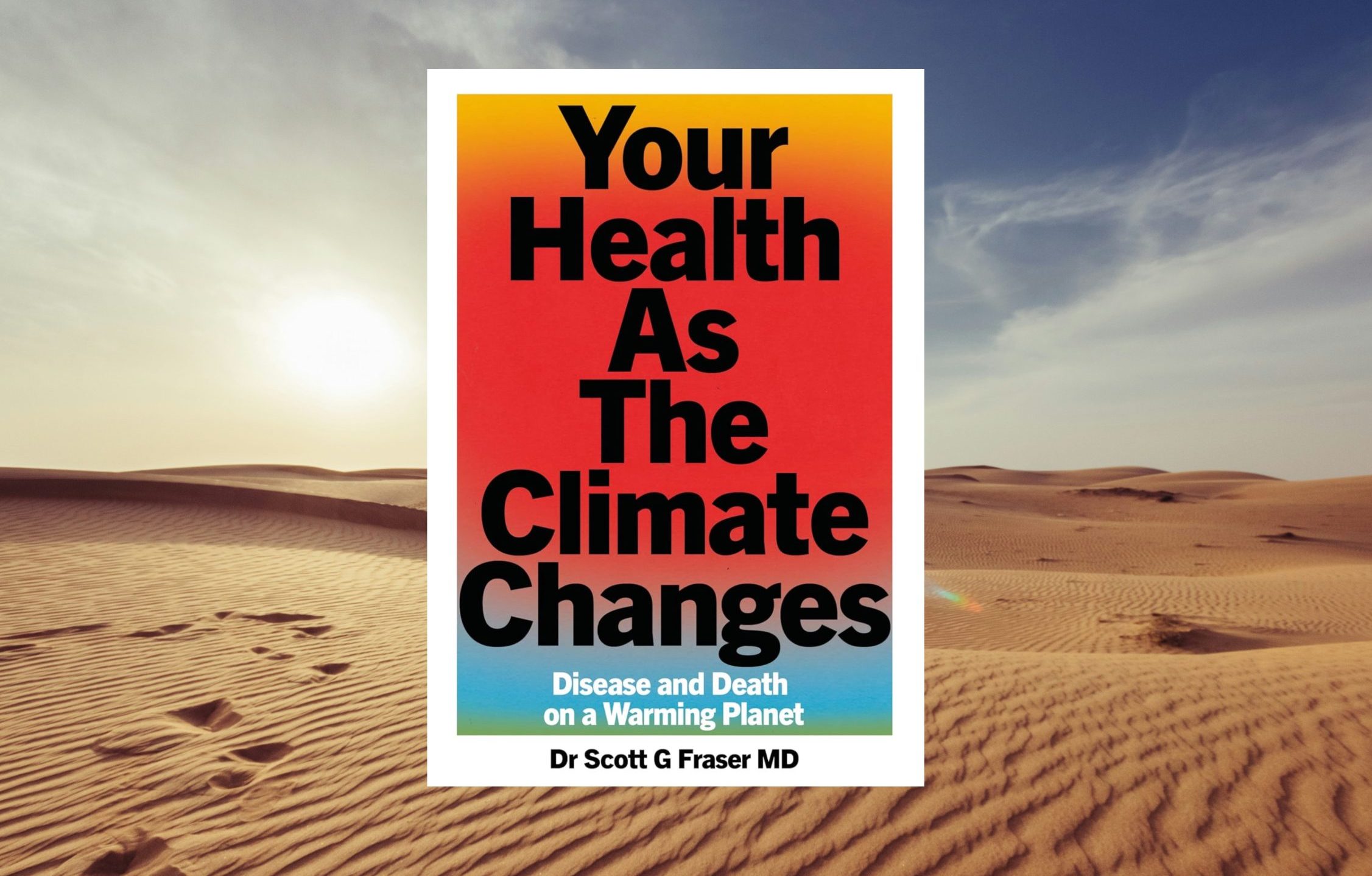
The author writes, ‘This book is written because not enough people are listening.’ I do wonder whether those who write about climate change in the medical press prematurely assume that they have a receptive audience. Journal articles on climate change and health often have a very limited word count to establish the scientific and medical consensus that underlies this existential threat to human health in a way that draws in the unconvinced or relatively ‘sheltered’ reader. By contrast, Fraser achieves this over the initial chapters and draws in the readers by showing how we are affected – the idea that “It’s your health too!” is implied by the very title. He goes on to suggest that, after reading those chapters (which describe the problem of climate change and its effect on nature and on humanity in general), if you still don’t believe that there is a thing called climate change or that it’s a problem of existential proportions, you probably shouldn’t bother reading any further. I was relieved to see Fraser is actually not telling the reader to put the book down, or deploying reverse psychology, but to read on. Early chapters survey the nature, causes and global effects of global warming. If the figures are too boring or not convincing enough, the author invites us to recall the January 2020 wildfires burning in Australia or the increased frequency of flooding.
If the figures are too boring or not convincing enough, the author invites us to recall the January 2020 wildfires burning in Australia or the increased frequency of flooding.
Readers of BJGP with no awareness of climate change may well have found their annual ski holiday becoming more expensive as the snow retreats up the mountains or a summer holiday ruined by temperatures too high for swimming and sunbathing. I am sure that there is a pool of medical experience of climate effects among our readership too, whether global or local.
Fraser takes a holistic approach to health, arguing that our health is as affected by man-made disasters as by climate or the changes to diseases caused by it. Illness and disease with a causal link to climate change are systematically addressed in later chapters. Some of these effects are existential and geopolitical in terms of cause and effect, such as was famine and mass migration (of people and tropical diseases). Some are very specific: Perhaps the link between heatstroke and acute kidney injury is one that GPs should be on the look out for in hot summers, among the spuriously-raised potassium blood test results. There are case studies in the book that may be surprising to the sheltered reader, such as avocado farming in Mexico requiring 4000 Olympic swimming pools worth of water per day. The resultant drain on aquifers is implicated in local earthquakes. All of which makes talk of fracking for fossil fuels in the UK even more scary. I also think twice about my breakfast menu. I am saddened but unsurprised by the discussion about how much climate change disproportionately affects vulnerable populations around the world. The one-thing-after-another-ness of the threat by threat and disease by disease chapters is somewhat overtaken by the content.
It is hard to read about the direct effects of heat on the human body- they are scary. Mild heat effects include redness of the skin, swelling of fingers and toes, muscle cramps and rashes.
It is hard to read about the direct effects of heat on the human body- they are scary. Mild heat effects include redness of the skin, swelling of fingers and toes, muscle cramps and rashes. Moderate effects include dizziness, confusion and fainting and organ failure, resulting in nausea and vomiting, breathlessness and diarrhoea as well as a paradoxical feeling of cold. Severe effects include organ failure and widespread inflammatory damage leading to confusion, fits, myocardial infarction, and thromboembolic events. At external temperatures above 45°C even with low humidity, human biology begins to break down. In humid environments however (what is referred to as wet bulb temperature), the number is around 35°C as Many readers may have visceral memories of heat exhaustion, or worse.
The book closes with a call to action. Every little helps – and ‘Your health as the climate changes’ is eminently recommendable, both to colleagues or clients. I dare you to ostentatiously read this book on the beach or by the swimming pool, in the pub or at the bus stop (with due regard for personal safety obviously). The Peruvian folk tale of ‘The hummingbird and the forest fire’ makes the point as does a final section on climate science resources, climate fiction and climate movies. I am pleased to see that ‘Ministry for the Future’ and ‘WALL-E’ make the cut, though sad that ‘The Wall,’ by John Lanchester, does not – see my earlier review. It’s a book that once read, the reader might refer back to – an index might be nice to have, but the clear layout of the chapters makes this mostly redundant. This book is informative and shocking but also surprising. It quite literally brings home the biggest global health threat of the 21st century (so far).
Reference: Papanikitas A. Three novels for planetary health. Br J Gen Pract. 2023 Aug 31;73(734):419-420. DOI: 10.3399/bjgp23X734901
Featured book: Scott G Fraser, Your health as the climate changes: Disease and death on a warming planet, 2025, Eyewear Publishing, ISBN 9781915406781, 249 pages, Hardback £22.50
Featured photo by Giorgio Parravicini on Unsplash