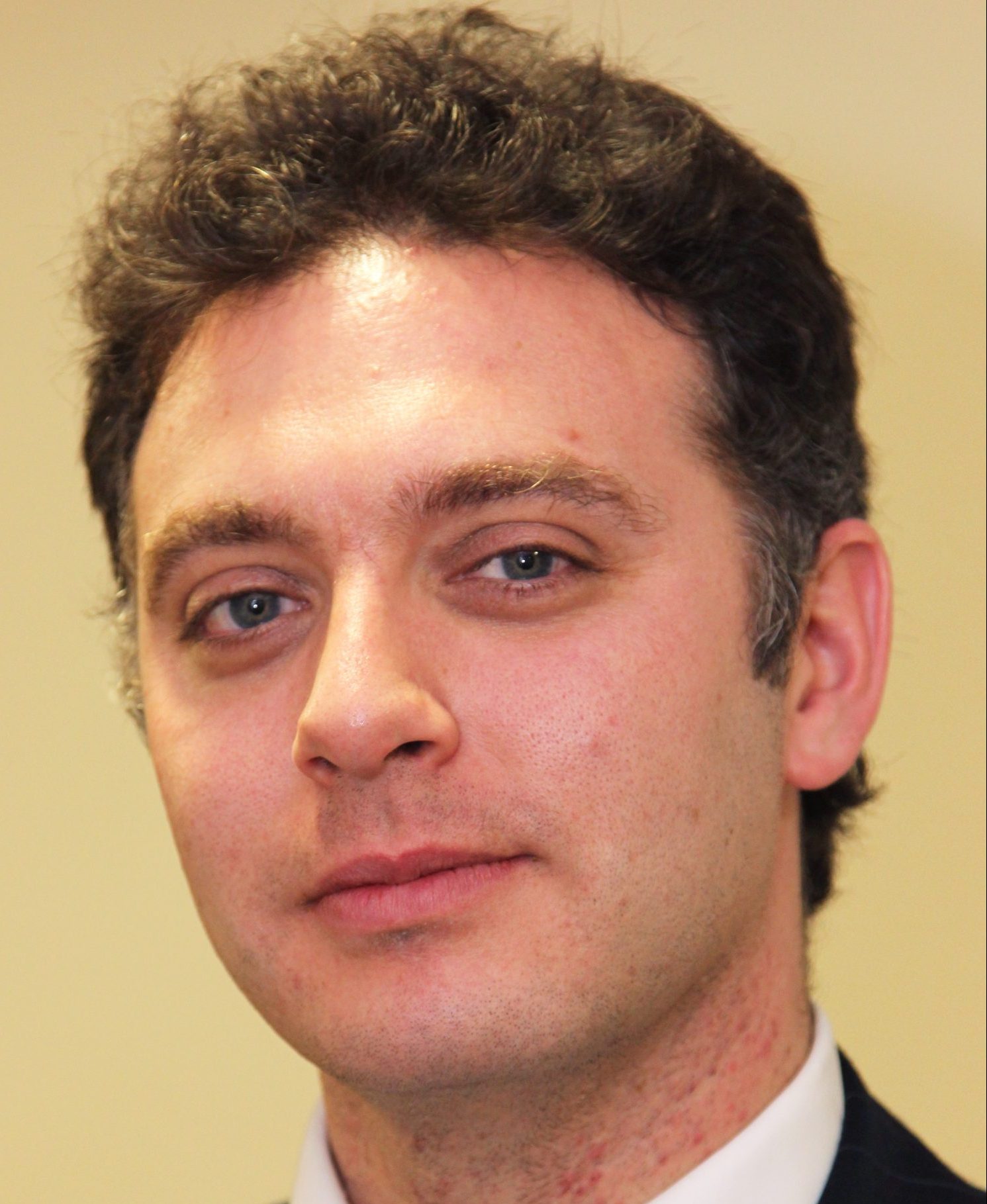

 Andrew Papanikitas is Deputy Editor of the BJGP.
Whilst this book is a masterfully succinct demonstration of how to use the four principles of bioethics and allied concepts in practice, its power lies in Daniel Sokol’s compelling storytelling. Once again the author shares a little of his background and his continued skin in the game. A postgraduate student in the history of medicine, he took a masters degree in medical ethics at imperial College London and then PhD on truth telling in medicine, and has since observed, studied and taught ethics in medicine around the world. His current role as a barrister only sharpens his take on the importance of an ethical approach. I particularly like his quotation from William Osler “...make the lesson of each case tell on your education. The value of experience is not in seeing much but in seeing wisely.“
Sokol describes how he uses the four principles approach as an analytic framework [but] admits that like any tool these can be used poorly.
Sokol describes how he uses the four principles approach as an analytic framework (to make issues visible and open to discussion at the bedside), when teaching, and in committees. The principles’ strength lies in their adaptability to cultural differences around the world. To varying degrees most if not all cultures will endorse the idea of medical beneficence, non-maleficence, the respect for autonomy, and justice.
Sokol admits that like any tool these can be used poorly. He tells us of a doctor who told family members that he was guided by the principle of maleficence (note the absence ‘non’). My own take on this is that I frequently find students attempting to prioritise autonomy at any cost rather than respecting the principle of autonomy, which of course means giving weight to various kinds of freedom, the ability to express it and the consequences of those expressions. It is perfectly possible to respect someone’s autonomy, but still not do what they want. Sokol gives the example of a 2010 UK court of protection case. This involved a 55-year-old woman with a learning disability and endometrial cancer. Although she needed an operation, her fear of needles in hospitals meant that she repeatedly failed to attend for treatment. The judge ruled that if the she could not persuaded to attend, an anaesthetist could go to her home, put a sedative in her drink, and restrain her while she recovered from the operation. Similarly, he unpacks the principle of non-maleficence the expression, “First do no harm,” and find it a little silly -most of what clinicians do can or does cause harm in some way. What is important is that the benefit significantly outweighs the harm. He comes up with a Latin version of this, “Primum non plus nocere quam succurrere.“
Sokol uses national law as a kind of ethical consensus or buckstop. This is illustrated by the chapter on consent. We are introduced to the legal definition of consent which is defined as a voluntary uncoerced decision made by sufficiently competent or autonomous person on the basis of adequate information and deliberation to accept rather than refuse some proposed course of action. Common errors in consent cases that he has come across include: failing to present reasonable alternatives, failing to mention risks, failing to be accurate when talking about risks or benefits, failing to record details of the consent conversation, failing to take enough time, failing to obtain consent in good time, and confusing advice with persuasion. This last is a real ethical humdinger for GP’s that is even commented on by Roger Neighbour in The Inner Consultation when he talks about the general practitioners’ apostolic function. Is the job of clinicians to advise, recommend, or persuade?1 This question is a moral one but there is a legal aspect as well. Sokol reminds us. The famous Montgomery case hinged on the fact that the patient was not given all of their options -the obstetrician believed that the recommended course of action was the most prudent and withheld options that might lead to a worse predicted outcome. So perhaps the key to the problem is in the undue aspect of influence rather than influence itself. As I tell my medical students when they discuss how to introduce themselves to patients, they have to do so in a manner that allows the patient the possibility of saying no.
I may be biased (see my review of the author’s other recent book),2 but I believe this self published monograph punches above its weight. Not only does it address key ethical issues – these give students and clinicians a fighting chance to do the right thing and to reflect on experience with some principles and language- but it also addresses some of the elephants in the ethical room. He picks up on the factors involved in trust and trustworthiness. These may include things like dressing in a professional way and being reliable in your transactions. They also include being open about whose interests dominate an inter interaction. I’ve written elsewhere about the need for self-reflection3 and find myself nodding along as Sokol suggests that, if patients think that their doctor is more interested in money, reputation, or getting home early than helping them, then this will compromise trust.
The one most important piece of advice in this book is the single step that reduces that greatly reduces the risk of getting it wrong … It is to get help.
The one most important piece of advice in this book is the single step that reduces that greatly reduces the risk of getting it wrong. Sokol wearily reflects that very few of the clinicians he teaches in his remedial ethics class take that step. It is to get help. Interestingly, he embraces artificial intelligence including large language models as better than nothing, commenting that the four principles is currently the default bioethical framework used ChatGPT.
The book closes with an answer to what medical ethics looks like in practice. This requires moral perception (the abilities to see the moral aspects of a situation), moral reasoning (which is working out what the right thing to do is), and finally moral action (which is doing that right thing). He gives examples of how each of these steps can fail in real life and how these failings may represent social precious or educational deficiencies but nonetheless land students and clinicians in trouble. I have a sincere warm glow as I read that ethical decision-making, that is decision-making that is ethical rather than decision-making by ethicist, ought not to require but nonetheless does require moral courage. The barriers to doing the right thing are real.
I think that this compelling little book should be widely read by students and qualified clinicians. It addresses both patient unmet needs and doctors’ educational needs.
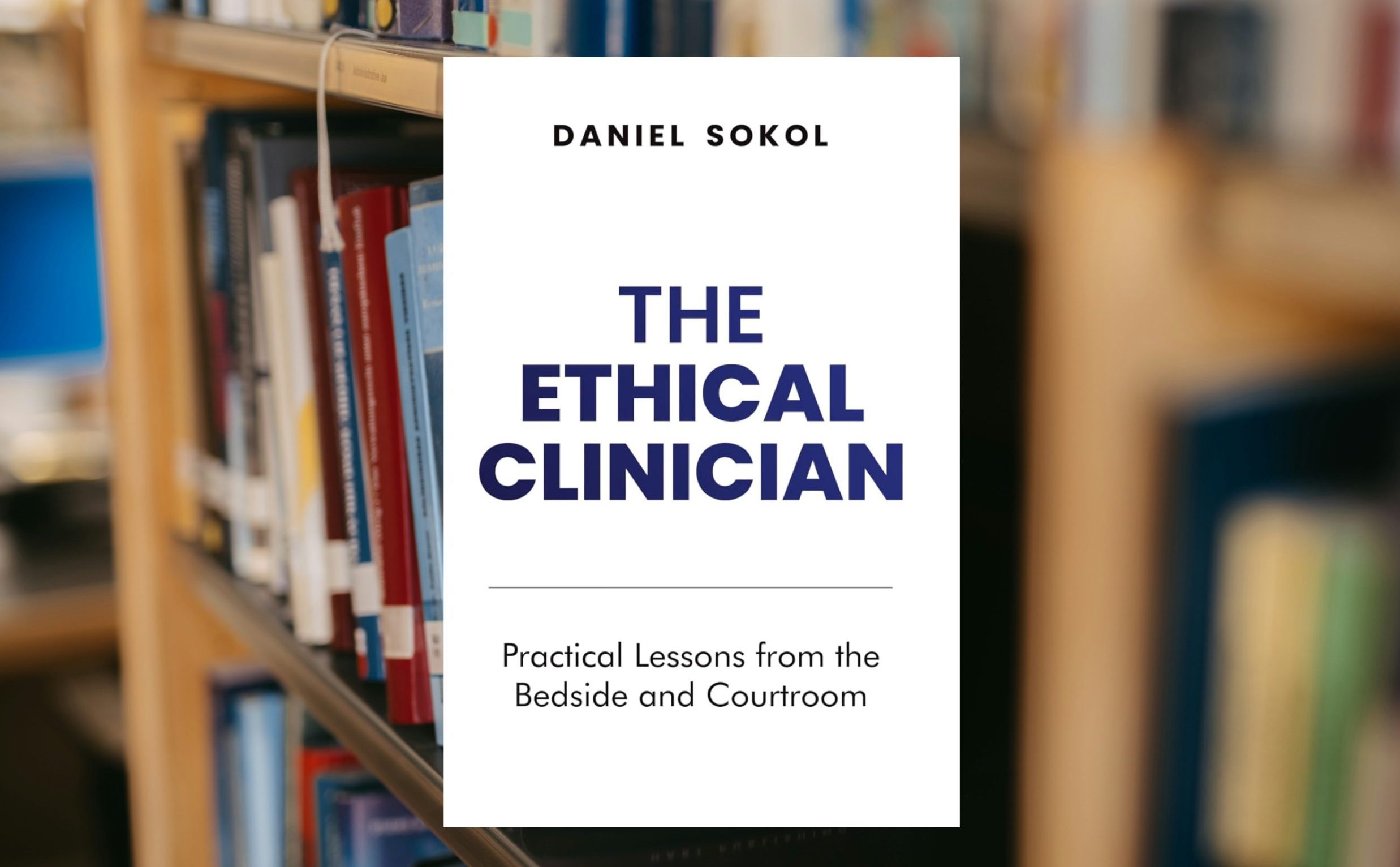
Featured book: Sokol D, The ethical clinician: practical lessons from the bedside and the courtroom, Published by Daniel Sokol, London 2026, ISBN 9781036951061, Paperback £7.99 (also available as an e-book). Available via Amazon.
References:
- Neighbour R. Checkpoint 3 (Handover): Communication skills. In: The inner consultation. 2nd ed. Oxford: Radcliffe Publishing; 2007, pp. 176–201.
- Papanikitas A. Books: From error to ethics: Five essential lessons from teaching clinicians in trouble. Br J Gen Pract. 2025 Aug 25;75(758):417. doi: 10.3399/bjgp25X743097
- Papanikitas A. Self-awareness and professionalism. InnovAiT. 2017;10(8):452-457. doi:1177/1755738017710962
Featured Photo by Krists Luhaers on Unsplash