
 Frances da Cunha is a retired GP and trustee of the Human Values in Healthcare Forum.
A 90-year-old woman presents with resistant hypertension, already suffering the side effects and interactions of her long list of prescribed medications. Another, following a fall while in residential care, immobility, cardiovascular disease, severe heart failure, cognitive decline, and osteoarthritis. The acute medical admissions are overwhelmed by patients presenting with the dual problem of complexity and advanced age. Do we treat the patient or the condition? How do we decide what is right for the individual patient?
Twenty per cent of global health care is of no benefit to the patient, with this figure rising to nearer 40% as we age. The evidence base for this heterogenous group is non-existent, since the gold standard randomised controlled trial is unlikely to have included people with the interplay of such a plethora of problems. Familiar? Where do we go for guidance? I suggest we turn to the practical wisdom and experience, common sense, and deep understanding of the patient’s perspective that Lucy Pollock so skilfully explores in her latest book.
“Now living longer than ever before, we are presented with more choices as to how we age.”
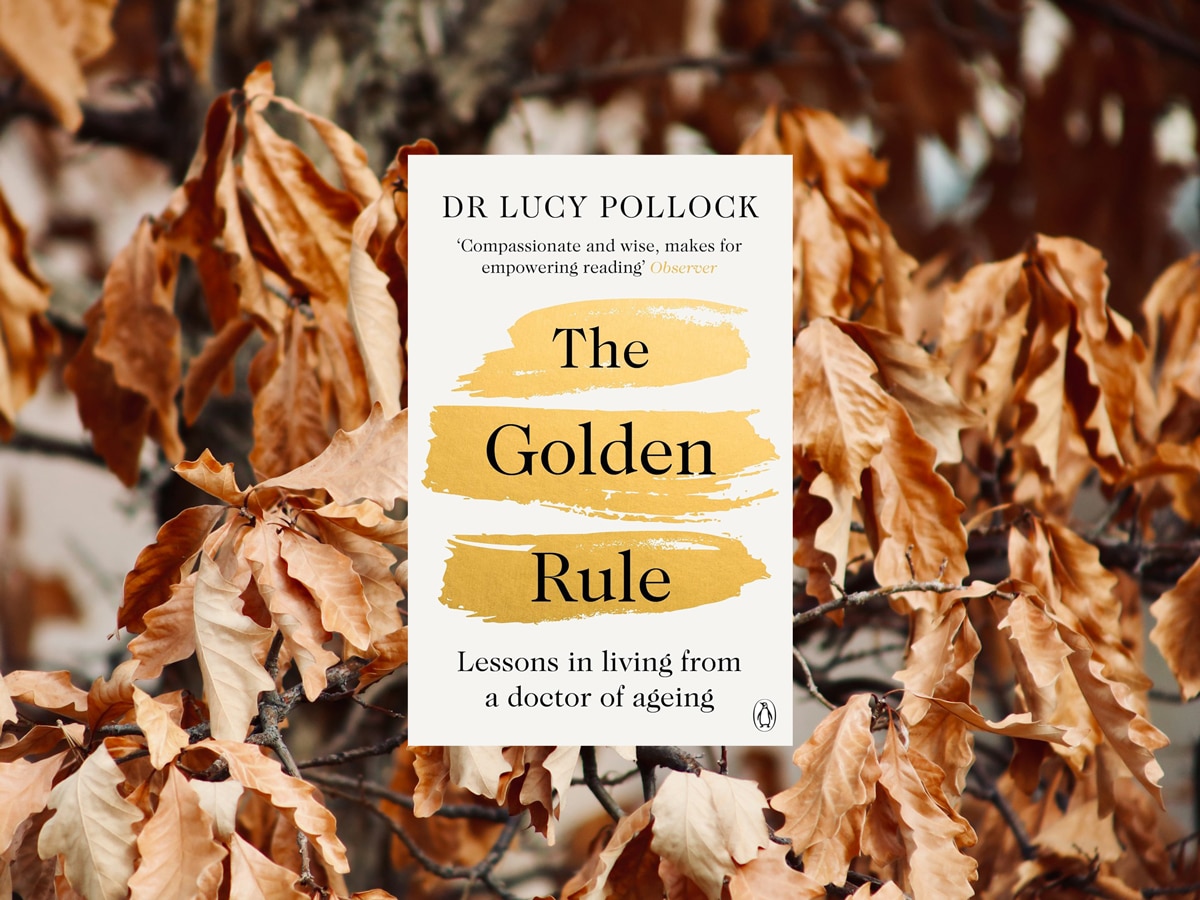
‘Plan A stay young forever, and Plan B read this book’ is boldly stated on the back cover. Given Plan A is a no go, implement Plan B, as this book comprehensively covers the need to think systemically about ageing. In it, Dr Lucy, as she is affectionately known, brings together her personal reflections, her extensive clinical experience, her observations of caregiving, and her deep understanding of social policy. Author of The Book About Getting Older, in which she explored many aspects of ageing, and tackled the complex and often delicate issues we prefer to avoid — resuscitation, falls, dying, and declining cognition — her latest book, The Golden Rule, is helpful to both the older person and those looking after them, addresses what is and isn’t working in the way we care for the older population, and highlights the disconnect between what patients want, what doctors do, and how they are treated by family and society.
Now living longer than ever before, we are presented with more choices as to how we age. By exploring what contributes to our happiness and wellbeing, Dr Lucy guides us towards flourishing in older age. By sharing what she has learned from her patients, who she describes as courageous, she crystallises how they deal with vulnerability and uncertainty, and how they cope with ageing.
Covering a breadth of topics from dying without children and grandchildren to the potential impact of artificial intelligence and the contentious aftermath of the COVID-19 pandemic and its adverse impact on older people, she acutely observes how we fail our older patients on many levels — individual to societal. Dr Lucy observes their courage as they battle with multiple comorbidities and a multitude of medications — some of which neither do them any good and may do harm. Does that fit with our ethical code of practice? She explains how we need to restore judgement to medicine and adapt to the reality of old age, together with the compassionate support of families and carers.
The book uses the lessons from the pandemic to highlight how blanket protocols around avoidance of infection and bureaucracy harmed the lives of older people whose wellbeing suffered through loss of dignity, connection, and relational care. It concludes that ethical and ‘good care’ requires judgement, inclusivity, really listening to the patient’s voice before applying medicine, and technology. It illustrates the moral injury and distress of the staff in nursing homes, who were charged to enforce protocols, so often at odds with their judgement. Systems can harm patients and the workforce when discretion and kindness are squeezed, leaving a legacy or moral residue, yet unresolved.
“Systems can harm patients and the workforce when discretion and kindness are squeezed, leaving a legacy or moral residue, yet unresolved.”
Attracted to care of older people when at the Whittington Hospital, it was the challenge of the medicine, the team, and the people that caught her attention. A specialty in its infancy, now increasingly complex with the choice of medical interventions at our disposal. Citing the success of ‘pre-op’ clinics, established to optimise outcomes of surgery, she demonstrates that by addressing patient expectation and understanding of the risks of intervention, and non-intervention, a more individualised approach ensued. Generalising this model to all treatment decisions, medical and surgical, raises the potential to reduce iatrogenesis.
The author — a doctor, a woman, a mother, a sister, a daughter, and a patient — shows how her multifaceted background has shaped her way of practicing. Interlacing the narrative are stories that have shaped her life and experience, which presumably influenced her career choice. Generously sharing personal experiences, such as the sad death of her father when she was a mere child or a complication of a pregnancy, she skillfully deconstructs what happened and reconstructs events for the reader’s benefit. This rich tapestry of her life, coupled with her professional practice, helps her explore the interface of science and humanity, demonstrating the art of medicine.
The Golden Rule is a ‘lesson in living from a doctor of ageing’ and it is full of hidden gems and pearls of wisdom from her ability to acutely observe beyond what is and isn’t being said. It is written in a style that exudes warmth, affection, compassion, empathy, and intelligence. Her acute observation of the smallest detail, combined with a well-honed ability to relate it to so many other memories and experiences, results in a compelling read. Far from a didactic lesson, threads are skilfully left hanging, at times deliberately unfinished, to provoke our thinking and reflection.
Stories are important and help to shape our memories. The combination of her fascinating anecdotes and her unique and interesting perspective as a doctor, always curious, never afraid to tackle the thorny issues, showcases her model of care. As clinicians we know so little about our patients until we ask those questions that go beyond the history taking algorithm of the presenting problem, and we are better for doing so. There can be surprising results to the open, enquiring clinician, as there is so much more to learn by highly tuning our antennae and understanding what really matters to people.
You may have guessed the golden rule is ‘do how you would be done by’. There is a strong sense that this is how Dr Lucy treats everyone, not only her older patients. So many older patients claim that old age doesn’t come on its own, so there is something in this book for everybody. After all, we all have or have had parents and grandparents, and we are the ageing population and need to shape what happens to us in the future.
What would Dr Lucy’s advice be to herself and us all? Beware, spoiler alert — far from complex medical intervention it would be to stay connected, be curious, socialise, maintain optimism, and, inevitably, do your pelvic floor exercises.
Featured book: Lucy Potter, The Golden Rule: Lessons in Living from a Doctor of Ageing, Penguin, 2025, PB, 352pp, £10.99, 978-1405953245